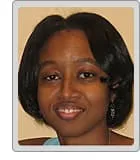
Breast cancer survivor Erica Seymore, 34, lives in the Miami area. She never felt any lumps in her breast. But she noticed a red, itchy mark on her left breast, and also felt some pain that would come and go in that breast. "It would be like a pinch and then it wouldn't bother me for a while, and then I'd get a pinch again," Seymore says. "I just thought something might have bit me and I was having a reaction to it."
But the rash didn't go away; it got larger. So Seymore went to her gynecologist, who sent her to another doctor for a biopsy and MRI. Those tests showed that she had inflammatory breast cancer, a rare and aggressive type of breast cancer.
Difficult choice: Seymore was diagnosed in February 2009 and is getting treated at the Sylvester Comprehensive Cancer Center at the University of Miami Miller School of Medicine.
First, Seymore got chemotherapy to shrink her breast cancer. And she knew she needed surgery to remove her left breast.
Deciding what to do about her right breast, which did not show signs of cancer, was hard. Should she keep it because it appeared healthy, or have it removed as a precaution?
"I was really struggling there, and I had to pray about that," Seymore says. "It so happened that the week of my surgery, the doctor called me and said, 'You really don't have to do both. You only really need to do one because it's only in that one.' So it was like the Lord answered my prayers. That's what helped me make the final decision."
Recovering from mastectomy: "After the surgery, I was pretty fine, actually," Seymore says. "I wasn't in as much pain as I thought I was going to be in. I did have some, but it wasn't excruciating ... it hurt to reach for things."
"I didn't use the painkillers because I really don't like to use those unless it's really, really necessary," Seymore says. "Right now, I'm working on the exercises to get more movement in my arms and my shoulder."
Seymore will get radiation therapy. "That's the next step," she says. And she will take the drug Herceptin to keep her breast cancer at bay.
Seymore plans to get her left breast reconstructed later on. "I have to wait a year, finish off my radiation," she says.
Leaning on faith: "At first, it was kind of a relief to know what the problem was," Seymore says of her diagnosis. "Not to say that I was overjoyed or anything with the fact that it was cancerous. But for me, the only way I have handled it is through my faith. I've been praying for myself and I've had other people praying for me, and so I've just been relying on the Lord's strength. It's very helpful."
Seymore says she has no family history of breast cancer and never thought it would happen to her, especially at a young age. Like many other young women, her attitude before her diagnosis was, "I don't see that ever happening to me."
"But when it happens to you," Seymore says, "it's how you deal with it, I think, that really defines your character. It's easy for all of us to be like, 'It's the end of the world,' or 'I don't know how I'm going to get through this,' but for me, myself, personally -- and I would say for anybody -- you have to rely on your faith, your family, and your friends to see you through these things."
Seymore has this advice for other breast cancer patients: Schedule some time for yourself every day for an activity unrelated to cancer. "The activity could be reading, writing in a journal, scrapbooking, or reorganizing a drawer," Seymore says. "Just make sure you do something that takes your mind off the illness." Seymore also has some advice for the families of people with breast cancer: "Treat the 'patient' the same" as before. "The illness doesn't define who we are."
Share your breast cancer stories on WebMD's breast cancer message board.