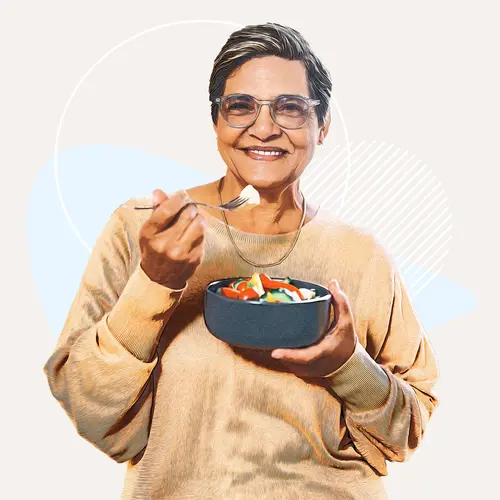

Dean Ornish, MD, has already shown us what it's possible to do with a healthy lifestyle. Now he's showing us how to do it.
Ornish's plant-based diet, exercise, and lifestyle plan can reverse heart disease. But the strict Ornish plan only shows what's possible, not what might be right for you. In his new book, The Spectrum, Ornish puts the emphasis on finding your own personal place in a spectrum of healthy choices. For Ornish it's not all about diet and exercise. He gives equal weight to stress reduction via mindfulness and meditation.
So how do you go about making the changes needed to improve your overall heart health? WebMD turned to Ornish for some answers.
What is mindfulness? Why do you say mindfulness is part of healthy eating?
Mindfulness is just the practice of paying attention to something. Meditation helps to promote mindfulness, because when you pay attention to something you do it better.
And on the sensual level, when you pay more attention to something, whether it is food, music, sex, art, or massage, you enjoy it more fully and you don't need as much of it to get an even greater amount of pleasure.
Pay attention to how things affect you. Then your choices come out of your own experience. It's not just because some book-writing doctor told you to change. You change because you connect the dots between what you do and how you feel.
When you exercise, eat healthier, and meditate, many changes occur -- quickly. You think more clearly. You have more energy and you need less sleep. Your skin doesn't wrinkle as much. Your heart gets more blood, so you have more stamina. And your sexual organs get more blood, so you have more sexual energy.
These changes are sustainable because they come from your own experience.
Which is more important to avoid, cholesterol or saturated fats?
Saturated fat will raise your blood cholesterol levels about twice as much as the same amount of dietary cholesterol will. But both are important. You only find cholesterol in animal products. You often find products that say they are cholesterol free, but may contain palm oil, which is high in unsaturated fat. So it is important to take note of both.
Are unsaturated fats beneficial?
I don't know that unsaturated fats are necessarily good. That is one of the few differences I have with people like Walt Willett at the Harvard School of Public Health. They say it does not matter how much fat you eat as long as it is unsaturated -- but it does.
First of all, fat is very dense in calories, and it doesn't matter whether it is unsaturated, monounsaturated, or saturated. Fat has 9 calories per gram, protein and carbohydrates have only 4 calories per gram, so when you eat less fat you are going to consume fewer calories without having to eat less food.
And studies show that total fat is related to diseases, such as breast cancer, and not just to saturated fat. So it is important to be mindful of both.
Are any fats good for you?
The truly good fats are not so much the unsaturated fats as the omega-3 fatty acids you find in fish oil and salmon and in some plant-based foods like flax. Part of the problem when you eat unsaturated fat is that much of the unsaturated fat people consume is rich in the omega-6 fatty acids, which promote inflammation and autoimmune responses. The truly good fats are not so much unsaturated fats as omega-3 fats.
And you don't need that much of it. You can take 3 or 4 grams a day of fish oil and that is really what most people need. And you can also buy the fish oil that has all the bad stuff in fish removed -- the omega-6, the PCBs, the dioxins, and the mercury. Then you get all the benefits of eating the fatty fish but without the extra toxicities that are found in most fish these days.
Why is fiber an essential component of a heart-healthy diet?
Soluble fiber, in things like oat bran, is important for lowering cholesterol levels. It has a direct effect on cholesterol metabolism in your bile and in your liver.
Insoluble fiber is important for two main reasons: First, because it helps to push food through the intestinal tract faster. Second, fiber affects your blood-sugar levels.
The difference between refined carbs and complex carbs is that the complex, fiber-containing carbs aren't just not bad for you -- they are truly good for you. When you go from white to brown rice or from white flour to whole-wheat flour, you are going from bad carbs to good carbs.
That does two good things from a weight standpoint. You fill up before you get too many calories. And you slow the absorption of foods into your bloodstream.
If you eat high-fiber carbs, your blood sugar level goes up a little and stays there -- so you're getting a good source of energy. But bad carbs get absorbed very quickly. Your blood sugar is going to zoom way up. Your pancreas pumps out insulin to bring it back down, and the insulin accelerates the conversion of sugar into fat.
This causes all these swings in energy. Your blood sugar doesn't just go back to where it started before it got too high -- it goes way down. That increases your carb craving, and you're stuck in a vicious cycle.
It is not necessary to avoid bad carbs altogether, but to limit them and use them in combination with other foods. If you're going to have dessert, have it after a high-fiber meal. Don't have it on an empty stomach.
How much can soluble fiber lower cholesterol levels? How much soluble fiber do you need to eat to get this benefit?
It depends on the individual. There is variability, and this is partly genetically determined. The best thing is to find out what works for you.
The issue is, lowering cholesterol is not just one thing. So often people are looking for a magic bullet: Oat bran is going to cure it, or Lipitor is going to cure it, or whatever. What you want to do is combine a number of different things that make a difference.
If you are eating mostly foods that are plant-based, they tend to be rich in fiber anyway. It's just that it all comes organically and naturally instead of having to add a spoonful of fiber to your food.
What are plant stanols/sterols, how do they work, and where can you find them?
These phytosterols are essential components of plant membranes. They resemble the chemical structure of cholesterol. They are present in small quantities in vegetables and fruits and nuts and berries and so on, and they lower your blood cholesterol.
They seem to work by affecting both the absorption of the food and the processing of it. Plant sterols help lower LDL cholesterol by blocking its absorption. They compete with cholesterol in the digestive tract in the formation of micelles, the tiny particles that your body uses to transport cholesterol and absorb it through the intestinal wall.
I don't want people to think, "I'll just take plant stanols and sterols and that will do it." Lowering cholesterol is a combination of several things that don't just add up but that are synergistic as well.
How will a diet rich in soluble fiber and plant stanols affect statins? Is it safe to take both?
I don't think you can get your cholesterol too low through diet and lifestyle. Cholesterol is not bad, it's just that we just get too much of it. Cholesterol is an essential building block. Because it is essential, the dietary requirement is zero because your body will always make all it needs.
It is possible you can get your cholesterol level too low through drugs. It is part of the reason why, if you can sufficiently lower your cholesterol through diet and lifestyle, it may not be just less expensive but medically more effective. Because the only side effects of diet and exercise are good ones.
When you're out having fun, do you break your own rules?
It is hard for me ever to go out to dinner without people apologizing for what they eat, or commenting on what I am eating. I don't care what you eat, that is your business. But I indulge too. My particular indulgence is chocolate.
Indulgences don't matter as much as your overall way of eating and living. If you indulge yourself one day, eat healthier the next. The language of behavior change has this moralistic quality -- I cheated on my diet because I indulged myself. I am a bad person because I ate bad food. That doesn't work, it only creates problems.
How do you balance indulgence and healthy eating?
Life is to be enjoyed. What is sustainable is pleasure and joy and ecstasy and freedom. If we try to control ourselves or others, we do not get sustainable change -- and we just make ourselves and others feel bad.
If you overindulge a little, do a little extra exercise rather than feeling you are morally weak. The people who eat the healthiest are those who allow themselves indulgences once in a while.
And when you indulge, really enjoy it. If you just chomp down a piece of chocolate and don't pay attention to it, you get all of the calories, all of the fat, and none of the pleasure.
Instead, meditate on it. Savor it. Invoke all of your senses. Close your eyes, let it melt in your mouth. Notice how the flavors and textures change and evolve. You can get exquisite satisfaction with a very few calories. It is not just what you eat but how you eat.