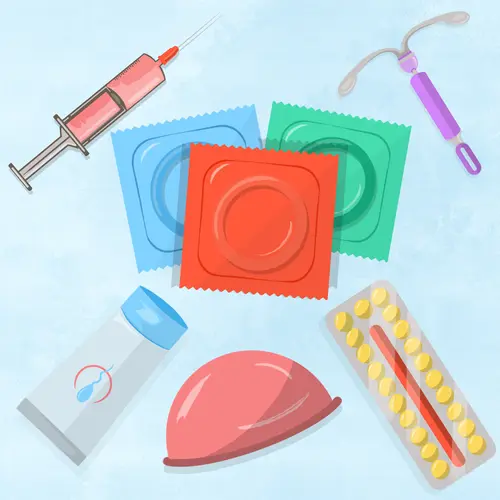
You have a lot of choices for birth control, from condoms to caps to pills. Find one that you're confident with -- and that you can commit to using every time you have sex.
Hormonal Birth Control
These include long-acting and short-acting forms of reversible birth control.
The long-acting reversible contraceptives (LARC) include intrauterine devices (IUDs) inserted in the uterus and hormonal implants placed just under the skin. These methods do not fail as often and fewer women become pregnant because they are always in place and last for a long time. Because of this, the failure rate is less than 1 in 100. LARC methods reduce the number of times women get pregnant when they do not want to, called unintended pregnancy. The number of abortions is also lower when women use LARC. LARC methods also help women in other ways and there are very few reasons they cannot be used. (The copper IUD is a nonhormonal IUD option. More information below.)
The short-acting options include birth control pills, stick-on patches, insertable vaginal rings, and shots. Depending on which you choose you’ll have to keep up with them daily or every few weeks or months. In real life, people may not be able to keep up with the method perfectly so typical rates of preventing pregnancy are lower, around 90%. You’ll need a prescription for them.
If you decide to take a birth control pill, ask your doctor how long you should use another form of birth control until the pill takes effect.
Barrier Birth Control
As the name suggests, these create a barrier to keep sperm from reaching an egg. You can get most of them at a pharmacy with no prescription.
Male condoms are reliable and cheap. Latex condoms are a good choice. They're durable and may be more effective against sexually transmitted diseases (STDs) than “natural” or “lambskin” condoms.
With typical use, the male condom is about 80% effective. If used perfectly every time, it prevents pregnancy 98% of the time.
A female condom is a thin, flexible, plastic tube that you would partially insert into your vagina, creating a barrier. Female condoms may also help against STDs. Female condoms are about 80% effective.
Other types of birth control work well in preventing pregnancy, but they don't protect you from sexually transmitted diseases (STDs).
The sponge is another non-prescription option. It's a small piece of foam, treated with spermicide, that you place high up in your vagina. It's between 68% and 84% effective. You can also use spermicides -- gels, creams, and foams -- with other birth control or on their own. Alone, they're about 70% effective.
A few options -- like the diaphragm, cervical cap, and cervical shield -- are available only by prescription. They're rubber or silicone barriers that you place far up in your vagina. They're about 90% effective in preventing pregnancy.
IUDs (Intrauterine Devices)
These are small, plastic devices that a doctor or nurse will insert into your uterus. The procedure is simple and quick, although a little uncomfortable. Once it's in position, the IUD will protect you from pregnancy for a long time.
IUDs that use hormones are good for 3-8 years depending on which type you get. The copper-T version -- which uses copper, a natural sperm-killer -- is good for up to 10 years. IUDs are about 99% effective in preventing pregnancy.
Vaginal Contraception
Vaginal contraception is inserted into the vagina prior to sex to create an inhospitable environment for sperm so it won’t reach the egg for fertilization. These come in several forms including foam, jelly, tablet, cream, suppository, or dissolvable film.
Spermicides contain chemicals which kill the sperm. They can be purchased over the counter and are 70-80% effective. They work better when combined with a condom or diaphragm.
A new nonhormonal gel called Phexxi is designed to use the body’s own vaginal environment. Normally, during sex, the vagina’s PH level rises to allow sperm to move towards the reproductive canal. This gel keeps the PH level of the vagina at its normally acidic level, killing the sperm. It is considered 90-93% effective and you would need a prescription for this.
Emergency Contraception
You shouldn’t consider this a form of regular birth control. It’s for use after unprotected sex or if your condom breaks. It can prevent pregnancy up to 3 to 5 days later, although the sooner you take it, the better.
Most emergency contraception products are so-called "morning after" pills, but the copper-T IUD works as emergency contraception, too. If you want an IUD, a nurse or doctor needs to put it in within 5 days of when you had sex. The copper IUD is the most effective form of emergency contraception. Women who are overweight or obese who want emergency contraception should consider using the copper-T IUD, since research shows that emergency contraception pills start to lose effectiveness for them.
There are three types of emergency contraception in pill form that are sold both with and without a prescription. Depending on the brand and dose, you might get one pill or two.
- Pills containing a hormone called levonorgestrel:
- My Way (over-the-counter)
- Plan B One-Step (over-the-counter)
- Preventeza (over-the-counter)
- Take Action (over-the-counter)
- Birth control pills can also be used as emergency contraception, but you have to take more than one pill at a time to keep from getting pregnant. This approach works, but it is less effective and more likely to cause nausea than levonorgestrel. Birth control pills require a prescription. Talk to your doctor or nurse to make sure you are taking the correct pills and dose.
- A third kind of emergency contraception pill is called ulipristal (Ella, ellaOne). You need a prescription to get it.
9 Tips for Using Birth Control
You’ll want to do these things so your birth control works:
1. Be prepared. It needs to be easy for you to use.
2. Check expiration dates. Condoms and other latex or plastic types of birth control can break down over time. Pills become less effective. Don’t rely on birth control that's past its expiration date.
3. Store it right. Light and heat can damage condoms and other forms of birth control. Never use a condom that's been in a car's glove compartment for a while or crammed in a wallet.
4. Follow directions. In the heat of the moment, you’re not going to stop to read the instructions in the box. So read up in advance.
5. Be careful when opening the condom wrapper. Don't risk tearing the condom by opening it with scissors or your teeth. The condoms can rip or tear.
6. Use the right size. A condom that's too small or big may not work.
7. Put condoms on correctly. Make sure you unroll it in the right direction. As you put it on, hold the tip to prevent an air bubble from forming. Air can make a break more likely.
8. Use lubrication. It lowers the risk of condom tears. Only use water-based lubricants. Don't use any that are oil-based, like baby oil or petroleum jelly. They can break down the condom. For better protection, use a lubricant with spermicide.
9. Have emergency contraception on hand. Even if you're careful, things happen. If a condom breaks, you may want to use emergency birth control just in case.
Permanent Birth Control
There are permanent options for birth control if you are certain you do not want to conceive in the future. Each of these are 99%-100% effective.
Women can choose to have a tubal ligation in which the fallopian tubes are closed off, preventing eggs from reaching the sperm. The procedure requires general anesthesia. This is also known as “having your tubes tied.”
For men, the permanent birth control option would be a vasectomy. During this procedure, your doctor causes a permanent interruption in the tube that allows the sperm to get into the semen.