
What Is a Ganglion Cyst?
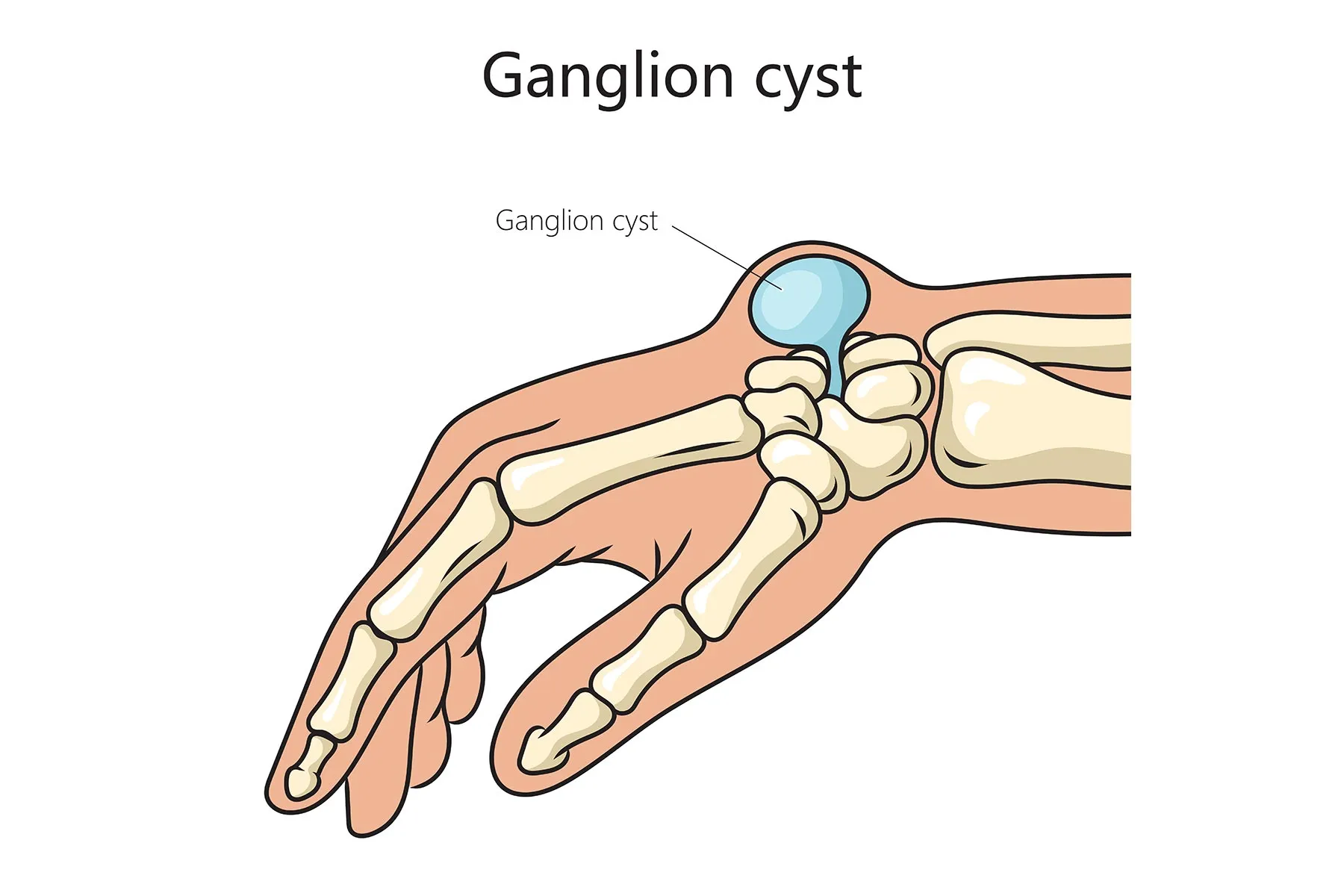
A ganglion cyst is a small sac of fluid that forms over a joint or tendon (tissue that connects muscle to bone). Inside the cyst is a thick, sticky, clear, colorless, jellylike material. Depending on the size, cysts may feel firm or spongy.
Ganglion cysts, also known as Bible cysts, most commonly show up on the back of the hand at the wrist joint but can also develop on the palm side of the wrist. They can also show up in other areas, but those are less common.
Ganglion Cyst Symptoms
Most ganglion cysts show up as a soft bump or mass that changes size but doesn’t move. They're often painless. Swelling may appear over time or suddenly. Other symptoms of a ganglion cyst include:
- A bump that goes away and comes back
- One large cyst or many smaller cysts
- Some degree of pain, especially after an injury or trauma from repeated movement
- Long-lasting pain that gets worse when you move the affected joint
- Pressure on nerves that causes tingling or numbness
- Weakness in the affected finger if the cyst is connected to a tendon
Types of Ganglion Cysts
Ganglion cyst on the wrist
Ganglion cysts on the back of the wrist are more common in young adults and usually disappear without treatment. Ganglion cysts on the front of the wrist usually show up in younger people or older people with arthritis.
Ganglion cyst on a finger
These cysts are usually found on the fingertip, just below the cuticle, where they're called mucous cysts. These are more common in people who are middle-aged or older.
Ganglion cyst on the thumb
These cysts are rarer than those on the fingers. They can cause thumb triggering -- locking or catching when you move your thumb -- as well as pain and stiffness in the joint.
Ganglion cyst on an elbow
Ganglion cysts on the elbows are rare but can happen. They can restrict joint movement and cause pain that comes and goes.
Ganglion cyst on a foot
Ganglion cysts can grow on the top of your foot or on your ankle. These usually result from bone spurs (bony outgrowths) or from damage to joints or tendons caused by arthritis.
Volar ganglion cyst
A volar ganglion cyst shows up as a pea-sized bump on the palm of your hand or at the base of your finger. These cysts can cause pain when you grip objects. Volar ganglion cysts tend to appear suddenly and don't get bigger or smaller. About half of the time, they disappear without treatment.
Ganglion Cyst Causes
Doctors don't know exactly what causes ganglion cysts. Injury or damage may cause the tissue of the joint to break down, forming small cysts that later create a larger mass. A flaw in the joint capsule or tendon sheath (layers of connective tissue that allow tendons to move smoothly over bones) also may cause the joint tissue to bulge.
Ganglion Cyst Risk Factors
Ganglion cysts are more common:
- In people aged 15-40
- In women (or those assigned female at birth)
- If you've had an injury to your wrist or finger
- If you do repetitive work with your wrists or hands
- If you have arthritis
- If you have inflammation of your tendons or joints
Ganglion Cyst Diagnosis
See your doctor, even if you have a bump without other symptoms. A physical exam is often all that is needed to diagnose a ganglion cyst, but your doctor may suggest other tests.
Your doctor may use a needle to draw out and analyze fluid in the cyst (known as a needle aspiration).
You may also have an ultrasound, a test that uses sound waves that bounce off tissues to form a picture. It can determine whether the bump is fluid-filled (cystic) or if it's solid, which may mean it's a tumor. An ultrasound can also detect whether an artery or blood vessel is causing the lump.
Your doctor may send you to a hand surgeon if the bump is large, solid, or involves a blood vessel (artery).
An MRI, magnetic resonance imaging, uses sound waves and a magnetic field to make an image of the inside your body where the cyst is located. An MRI can help your doctor see if the bump is a cyst or a tumor and if there's ligament damage.
An X-ray doesn't show cysts, but it may be used to rule out other issues such as a tumor or arthritis.
Ganglion Cyst Treatment
A ganglion cyst doesn’t need emergency treatment unless caused by a serious injury or damage. A routine check by either your doctor or a specialist in bones and joints (an orthopedist) is often enough.
Self-care at home
If your cyst isn’t bothering you, your doctor may tell you to keep an eye on it for any major changes. Many cysts disappear without treatment and never cause major problems.
In the past, some people used a heavy book (such as a Bible) to physically smash these cysts. Doctors don't recommend this because it hasn't been shown to keep the ganglion cysts from returning and could cause further injury.
Medical treatment
Your doctor may recommend one of these treatments if your cyst bothers you:
Aspiration. In this procedure, your doctor uses a needle to draw the liquid material out of the cyst. Then, they inject a steroid compound (anti-inflammatory) into the area, which is put in a splint to keep it from moving. Aspiration doesn't remove the link between the cyst and its tendon sheath or joint, so it will likely return.
Surgery. With this procedure, known as a ganglionectomy, the doctor uses a camera and small tools (arthroscopic surgery) to remove the cyst and the area around it -- called the stalk -- that attaches it to the joint. If the doctor can't get to the cyst through minimally invasive surgery, they'll need to make a larger cut and do open surgery. Both are outpatient procedures, so you should go home the same day. Recovery takes 2-6 weeks. Your doctor may recommend surgery if aspiration doesn't help and the cyst causes pain, interferes with function (especially when your dominant hand is involved), or causes numbness or tingling in your hand or fingers. The surgery is usually successful, and you'll have less than a 15% chance that the cyst will return.
Next Steps
After you've been diagnosed with a ganglion cyst and have chosen to have treatment, the follow-up will vary based on what you've decided to do.
- After aspiration, your doctor may ask you to start moving the joint soon after the procedure.
- After surgery, your joint is usually splinted for 7-10 days. A splint is a hard wrap that keeps you from moving your joint.
- Studies show that splinting for a long time doesn't really help, so your doctor may encourage you to use the joint soon afterward.
- Your doctor may ask you to return for a checkup after your surgery and will decide if you need physical or occupational therapy. Follow-up care will be based on your personal needs.
Ganglion Cyst Prevention
Because we don't know what causes ganglion cysts, we don't know how to prevent them. Doctors recommend that you get them diagnosed and treated promptly.
Ganglion Cyst Outlook
Ganglion cysts rarely cause major complications. Because they can go away on their own, or after a simple needle aspiration or minor surgery, there is a good chance that you'll have a full recovery. However, because ganglion cysts may come back after any of these treatments, a single treatment may not be enough.