
Shark Bite Overview
Sharks have had remarkable evolutionary success. The first sharks lived approximately 400 million years ago, about 200 million years before the dinosaurs. They have survived the reign of the large reptiles by another 200 million years.
The International Shark Attack File, which contains data on shark attacks from around the world, reports more than 120 shark attacks per year, with about 10-15 deaths each year. In comparison, about 1,000 people die from attacks by crocodiles; 1,500 from tigers, lions, and leopards; and 60,000 from snakebites.
Only about 40 of the roughly 1,000 species of sharks are documented attackers of humans, although another 20-30 species may occasionally attack humans. The great white shark has been implicated in more attacks than any other species. The tiger shark and bull shark are also known to be particularly dangerous. In general, however, any shark greater than 2 meters, or 6 feet, in length is potentially dangerous. Exceptions to that rule are whale sharks (the largest of the sharks), basking sharks, and megamouth sharks, all of which feed primarily on tiny plankton.
Other sharks normally eat fish, sharks, rays, squid and other invertebrates, sea mammals (such as porpoises, seals, and sea lions), sea turtles, and sea birds.
Sharks have remarkable senses. They have good vision, especially up close, and are especially sensitive to motion and contrast. A shark's sense of smell and taste is remarkable, with two thirds of their brains involved in processing this information. Sharks also have specialized organs called ampullae of Lorenzini, which detect tiny electrical currents, such as those put out by active muscle contractions.
Shark attacks can be broadly categorized into the following 3 types:
- In a "hit-and-run" attack, the most common type, the shark takes a single bite and does not return for more. Experts feel this attack may be because the shark mistakes a human for its normal prey.
- In a "bump-and-bite" attack, the shark bumps the victim prior to returning for further bites.
- In a "sneak attack," the shark bites without warning, and then follows up with further attacks.
The last 2 types of attacks, though less common than the hit-and-run attack, are the source of most severe shark bite injuries and shark bite deaths.
Shark Bite Symptoms
Most people do not know a shark is nearby before an attack. Some people receive only a bump from the shark, which likely occurs when the shark is only investigating what is going on at the water's surface. Because a shark's skin contains tiny toothlike structures called denticles, it is as abrasive as coarse sandpaper. Thus, a bumping can result in a significant abrasion (scrape).
Shark jaws contain multiple rows of sharp, serrated, triangular teeth, and are continuously replaced as they shed. Classic shark bites are crescent-shaped. Another common wound pattern is a series of parallel cuts caused by the shark raking its teeth on the person. Sharks bites can cause massive tissue loss, with a tooth-to-tooth biting force that has been estimated to approach, in the extreme, 18 tons per square inch. Most bites, however, result in cuts that are not deep, or puncture wounds that do not cause blood vessel or nerve injury.
When to Seek Medical Care
See a doctor for all shark bites. The doctor will evaluate the wound for significant damage, such as injury to blood vessels, nerves, or internal organs.
Exams and Tests
A person may not always know whether the wound came from a shark or another fish, such as a barracuda. More often, encounters may result in minor wounds, such as abrasions from the rough skin when bumped.
Shark bites can cause significant bleeding and tissue loss and are often distinguished by the crescent shape or a series of parallel cuts. Bite victims may also have bone fractures (breaks). Others may carry debris, such as shark teeth fragments, that may have been introduced into the wounds during the attack.
Shark Bite Treatment
Self-Care at Home
Provide emergency care. Control any visible bleeding by applying direct pressure. Keep the victim calm. Provide warmth, since the victim may be chilled from the water and may be in shock.
Call 911 to transport the person to an emergency medical facility. A doctor should evaluate all wounds.
Thoroughly wash even minor wounds with soap and water. Cover wounds with clean gauze.
Medical Treatment
The doctor must first treat life-threatening injuries. With shark attacks, massive tissue loss or bleeding causes most deaths. The doctor will attempt to stop bleeding by applying direct pressure. IV fluids and blood products will be needed for any major wounds.
Some people with shark bites may need to be taken quickly to the operating room to remove dead tissue, control bleeding, and clean the wound thoroughly.
All wounds will need aggressive cleaning with fluids to help prevent infection. The doctor will inspect the wound closely for tooth fragments or debris left in the wound. An X-ray may help detect these foreign bodies. The wound will probably be closed (stitched) loosely because of the risk of infection. A tetanus booster is likely given if the person has not had one within the last 5 years. The doctor may start antibiotics to help prevent infection.
Next Steps
Follow-up
Keep a close eye on the bite wounds for evidence of infection. Seawater contains many bacteria not often encountered on land. If these cause infection, treatment requires appropriate antibiotics.
Follow up with a doctor if the wound appears to be worsening, as evidenced by increasing pain, swelling, or discharge (pus or reddish-brown fluid).
Follow up if a fever develops, red streaking originates from the wound, or blister formation begins near the wound.
Prevention
- Avoid the shark's favored hunting grounds. Sharks frequent drop-offs from shallow to deep water, troughs between submerged sand bars, and deep channels.
- Avoid the water if bleeding. Menstrual blood has not been shown to increase the risk of shark attack, but a shark in the vicinity can likely sense the blood.
- Avoid wearing or carrying shiny objects, such as jewelry or brightly contrasting colors.
- Spear fishing, fishing, and chumming the water will likely attract sharks.
- Erratic swimming or splashing at the surface may cause a shark to mistake a person for its natural prey.
- Beware especially of any shark greater than 2 meters, or about 6 feet, in length.
- Agitated swimming movements by a shark, particularly if accompanied by a raised snout, lowered pectoral fins, and hump-backed posture, may indicate aggressiveness.
- Avoid swimming at dawn, dusk, and nighttime hours when many sharks actively feed.
- Swim in a group, because sharks are more likely to attack if a person is isolated and alone.
Outlook
Injuries from shark bites can be minor or life threatening. Massive tissue loss and large amounts of bleeding most often carry a worse prognosis. Wound infections are also a serious concern. Having survived the attack long enough to reach medical care, however, makes it very likely that continued survival and recovery are possible.
Multimedia
Media file 1: Classic shark bites are crescent-shaped. Parallel cuts caused by the shark raking its teeth on the victim are also common. Image courtesy of Fazal Hussain, MD.
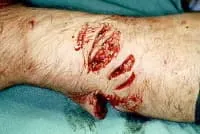
Media type: Photo
Media file 2: Image Courtesy of John Winfield, MD.

Media type: Photo