
Basically, "dislocation" means that the bones that form the joint have slipped out of their normal position in the joint. A joint can become dislocated if you injure yourself.
Dislocations can occur in any joint -- both the large joints (like the shoulder, hip, knee, elbow and ankle) or in the smaller joints (like fingers and toes).
Sometimes, the bones of the joint will shift, but not become totally dislocated. This is called subluxation (slippage) and can be a chronic problem. While the bones will shift back into their original position, you may feel some pain until they do.
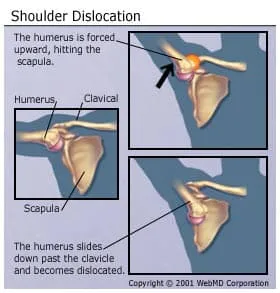
It is often hard to tell whether the injury is a dislocated joint or a broken bone. A severe injury can result in both a dislocated joint and broken bone. All are considered emergency situations requiring immediate medical attention.
What Are the Symptoms of a Dislocation?
If you've dislocated a joint, you'll know something is wrong because the symptoms are difficult to miss.
- You will have severe pain and will not be able to move that part of the shoulder, arm, or leg.
- You can usually tell by looking that the joint is not right. It will look deformed compared to the same joint on the opposite side. You may see an indention or a bulge near or in the socket.
- In many cases, the force of the injury stretches or tears the ligaments that hold the bone inside the joint.
- Often, there is swelling and bleeding inside the joint, causing a bruise.
- There may be nerve damage from the stretching of the nerves around the dislocated bone.
- You will have pain until the dislocation is "reduced," or put back into place by trained medical personnel.
What Should I Do to Help Someone With a Dislocation?
If you encounter someone who has been injured and you think they may have a dislocation, you can act, carefully:
- Keep the person still and reassure them.
- If the skin is broken by a fractured bone, or if you think there may be a broken bone under the skin, try to prevent infection. Cover it with sterile bandages before immobilizing the injury.
- Splint or sling the injury in the position you found it.
- Be sure to immobilize the area both above and below the injured joint and check the circulation.
- Apply ice packs to ease pain and swelling.
- To help prevent shock, lay the person flat, then elevate their feet about 12 inches (unless the injury involves this part of the leg).
- Cover the person with a coat or blanket.
- Get medical help. Do this immediately if you can’t completely immobilize the injury at the scene by yourself.
What Should I Avoid Doing for Someone With a Dislocation?
- Do not move the person unless the injured area is completely immobilized. And even then, don’t move them if there’s a chance of a head, neck, back, or leg injury.
- If the person has an injured hip, pelvis, or upper leg, don’t move them unless it is absolutely necessary. If you must, drag them by their clothing.
- It’s important not to try to move a dislocated joint back into place.This can damage the joint and its surrounding muscles, ligaments, blood vessels, and nerves. Trained medical personnel should be the ones to get it back in place.
- Don’t try to figure out whether the misshapen bone or joint can still function.
- Don’t give the person anything by mouth.
How Is a Dislocation Treated?
- The doctor will put your bones back into position. It might take a local anesthetic, if there’s a lot of swelling and pain.
- Then, the doctor might immobilize your joint with a sling or splint. You might use one for several weeks, depending on which joint is involved and the extent of damage to your joint and surrounding tissues.
- With rest and rehabilitation (like physical therapy), most dislocated joints will return to normal in several weeks.
- Some joints, like the shoulder and kneecap, are at an increased risk of dislocating again.
- Surgery may be necessary if you have weak ligaments and the joint dislocates often.