You get your routine mammogram and, soon after, you receive a call or letter from your doctor’s office. You’re told that you need to make an appointment for further testing. Although it can be unnerving to get this news, don’t panic.
Getting called back for additional mammogram views or a biopsy is pretty common and doesn’t necessarily mean you have cancer.
Fewer than 1 in 10 women who are called back after a routine screening mammogram for additional views or other tests turn out to have breast cancer. But you do need to get it checked out.
Use these tips to help you prepare for your follow-up appointment and to make the process easier.
At Your Follow-Up Appointment
You’re likely to get a "diagnostic mammogram” and an ultrasound at your follow-up appointment. The diagnostic mammogram might take longer than your routine screening mammogram did, because the technician may take more X-rays of the breast. They might, for example, magnify a specific area to get a more detailed picture or repeat the same views from the screening mammogram because those images weren’t clear enough.
Just as you did for the screening mammogram, you’ll need to undress above the waist and stand in front of the mammography machine. The technician will place your breast between two plates. The plates compress the breast to spread out the tissue for a few seconds while the X-ray is taken. These steps are then repeated for any additional X-rays of each breast.
If you have a hard time with the discomfort of a mammogram, you may consider taking over-the-counter pain medicine beforehand. If you’re not in menopause, try to schedule the mammogram after a menstrual period, when your breasts may feel less tender.
For the ultrasound test, you’ll lie on your back on an examination table.
The technician will put a clear gel on your skin and place a device called a transducer on the breast. The transducer releases high-frequency sound waves and picks up the echoes from these sound waves, which a computer translates into an image of the tissues inside the breast.
Ultrasounds don’t hurt, but the gel that the technician puts between the skin and the transducer may feel cold and wet. Ultrasound is often used to check a specific abnormal area that was found on a mammogram or a mass that your doctor can feel but that can’t be seen on the mammogram.
You may also get an MRI scan, particularly if your doctor finds that the suspicious area in your breast cannot be evaluated with mammograms and ultrasound alone. MRI scans use magnets and radio waves to create detailed pictures of the inside of the breast.
For this test, you lie on your stomach on a table that slides into the MRI machine, which is shaped like a narrow tube. The exam itself is painless, but the machine makes loud buzzing and clicking noises and the technician may give you headphones to mask this noise. Also, you may get a contrast agent injected into a vein in your arm and this can cause a tingling sensation.
Talking With Your Doctor
In most cases, the doctor who interprets your imaging tests will be able to tell you the results right away. It’s important to make sure this doctor has the results of your mammograms from the past few years so they can compare them with your new mammograms. An abnormality, such as a mass, that hasn't changed for a number of years may be more likely to be benign.
After reviewing your test results, the doctor may:
- Tell you that the abnormality is not of concern and you should return in a year for your routine mammogram.
- Recommend that you return for another mammogram in 6 months. Your mammogram and/or ultrasound showed an abnormality that is likely to be benign, but should be monitored to see if it changes over time.
- Advise you to get a biopsy to determine whether the suspicious area in your breast is cancerous. For example, microcalcifications (tiny deposits of calcium) in certain patterns and masses that are not cysts often need to be biopsied.
If You Need a Biopsy
A biopsy, if needed, will typically be scheduled for another day within the next week. Many breast biopsies are done as outpatient procedures.
During the biopsy, a small amount of tissue or fluid will be removed from your breast for examination under a microscope. Depending on the size and location of the abnormality and other factors, the doctor will most likely choose one of the following types of biopsies:
- Fine needle aspiration biopsy. The doctor inserts a very thin, hollow needle through the skin to remove a small amount of fluid or tissue from the suspicious area in the breast. You may or may not receive a local anesthetic first. In most cases, the doctor uses ultrasound equipment to help them guide the needle into the area that needs to be biopsied. You might have a little bruising after the procedure, but you won’t need stitches.
- Core needle biopsy. Using a slightly larger, hollow needle, the doctor removes several tissue samples from the suspicious area in the breast. Before inserting this needle, the doctor will numb the targeted area with local anesthetic. You’ll feel a brief stinging sensation when the local anesthetic is injected. The doctor will usually use ultrasound equipment or other imaging equipment to guide the needle to the target area. After a core needle biopsy, you won’t need stitches but you may have a small scar and possibly some bruising.
- Surgical biopsy. The surgeon makes a cut (incision) and removes all or part of the abnormal tissue. This procedure may be done under general anesthesia or you may be given a local anesthetic and a medicine that will make you drowsy. (Bring a friend to drive you home afterward.) Typically, stitches will be used to close the skin and you’ll have a small scar. You may feel sore for a few days after the surgery and your doctor may give you a prescription for pain medication. Surgical biopsies aren’t done as often as needle biopsies, but they’re required in certain situations.
After the biopsy, your breast tissue will be sent to a lab and a doctor called a pathologist will examine it under a microscope. The pathologist will determine whether or not cancer cells are present. The results of the biopsy are usually available within a week and your doctor will go over them with you. If you need additional tests or treatment, you may be referred to a breast specialist or surgeon.
Putting Your Mind at Ease
Many women feel anxious and uncertain while they’re getting follow-up exams and waiting for test results.
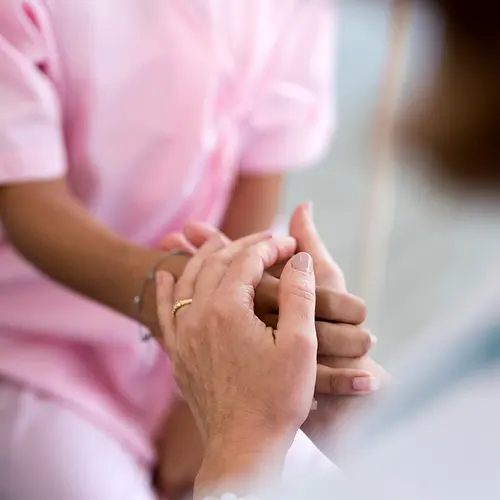
Doctors say that learning about the tests and writing down questions to bring to your appointments can help you feel calmer and more in control. They also recommend asking someone you trust to come with you, as a second set of ears when you talk with your doctor. That person can also take notes for you and offer their support.