
What Are Fractures?
A fracture is the medical term for a broken bone. It occurs when the physical force exerted on the bone is stronger than the bone itself.
Your risk of fracture depends, in part, on your age. Broken bones are very common in childhood, although children's fractures are generally less complicated than fractures in adults. As you age, your bones become more brittle and you are more likely to suffer fractures from falls that would not occur when you were young.
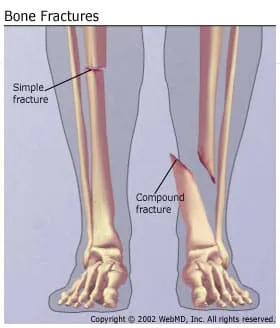
There are many types of fractures, but the main categories are displaced, non-displaced, open, and closed. Displaced and non-displaced fractures refer to the alignment of the fractured bone.
In a displaced fracture, the bone snaps into two or more parts and moves so that the two ends are not lined up straight. If the bone is in many pieces, it is called a comminuted fracture. In a non-displaced fracture, the bone cracks either part or all of the way through, but does move and maintains its proper alignment.
A closed fracture is when the bone breaks but there is no puncture or open wound in the skin. An open fracture is one in which the bone breaks through the skin; it may then recede back into the wound and not be visible through the skin. This is an important difference from a closed fracture because with an open fracture there is a risk of a deep bone infection.
Because of the unique properties of their bones, there are some defined fracture subtypes that present only in children. For example:
- A greenstick fracture in which the bone is bent, but not broken all the way through
- A buckle fracture results from compression of two bones driven into each other.
- A growth plate fracture at the joint that can result in shorter bone length
These fracture subtypes can present in children and adults:
- A comminuted fracture is when the bone breaks into several pieces
- A transverse fracture is when the fracture line is perpendicular to the shaft (long part) of the bone.
- An oblique fracture is when the break is on an angle through the bone
- A pathologic fracture is caused by a disease that weakens the bone
- A stress fracture is a hairline crack
The severity of a fracture depends upon the fracture subtype and location. Serious fractures can have dangerous complications if not treated promptly; possible complications include damage to blood vessels or nerves and infection of the bone (osteomyelitis) or surrounding tissue. Recuperation time varies depending on the age and health of the patient and the type of fracture. A minor fracture in a child may heal within a few weeks; a serious fracture in an older person may take months to heal.