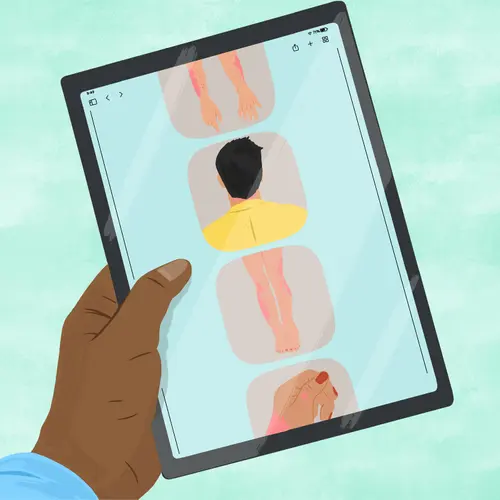
It can be hard to tell for sure if you have atopic dermatitis, also known as eczema. You’ll want to see a dermatologist or other doctor to find out.
At your appointment, your doctor will check your skin and talk with you about your symptoms, your health history in general, and any rashes or allergies that run in your family.
Based on that information, they'll decide if it’s eczema or something else.
Avoiding Atopic Dermatitis Triggers
Everyone’s eczema is different. Common triggers include stress, sweat, certain chemicals, dust, and pollen. Some foods can trigger flares in infants and children. A symptom diary can help you track your or your child’s triggers so you know what to avoid.
Try these tips to limit contact with triggers:
- Protect your skin, especially when the weather is cold and dry.
- Be careful with soaps, shampoos, and other commercial skin care items. Read the labels carefully.
- Rinse laundry twice to remove detergent residue.
View a slideshow to see top eczema triggers to avoid.
Home Treatment for Atopic Dermatitis
Good skin care is key. If your eczema is mild, that might be all you need, along with some changes in your daily habits.
If you have severe eczema, you may need to take medicine for it, too.
The basics:
Soap and moisturizer. Use a mild soap or soap substitute that won't dry your skin. You’ll also want a good moisturizer in cream, lotion, or ointment form. Smooth it on right after a shower or bath, as well as at least one other time each day.
If your eczema is severe, you may find that it helps to take baths once a week with a small amount of bleach added to the water. That kills bacteria that live on the skin of people with eczema.
Short, warm showers. Don’t take very hot or very long showers or baths. They can dry out your skin.
Stressmanagement. Get regular exercise, and set aside time to relax. Need a few ideas? You could get together with friends, laugh, listen to music, meditate or pray, or enjoy a hobby.
Get a humidifier. Dry air can be stressful for your skin.
Learn more about home remedies for eczema.
Medicines for Atopic Dermatitis
If your doctor decides you need meds to treat your eczema, those may include:
Hydrocortisone. Over-the-counter cream or ointment versions of it may help mild eczema. If yours is severe, you may need a prescription dose.
Antihistamines. Ones you take by mouth are available over-the-counter and may help relieve symptoms. Some of these make you drowsy, but others don’t.
Corticosteroids. Your doctor may prescribe these if other treatments don’t work. Always follow your doctor's directions when taking steroids by mouth.
Drugs that work on your immune system. Your doctor may consider these medicines -- such as azathioprine, cyclosporine, or methotrexate -- if other treatments don’t help. There are also prescription creams and ointments that treat eczema by controlling inflammation and reducing immune system reactions. Examples include pimecrolimus (Elidel), which is a cream, and crisaborole (Eucrisa) and tacrolimus (Protopic), which are ointments. You should only use these for a short time if other treatments don't work -- and you should never use them on kids younger than 2, according to the FDA. Coal tar is an old therapy but it is a good anti-inflammatory, Opzelura cream (JAK inhibitor) can be used for ages 12 and up.
Injectables. Dupilumab (Dupixent) is an injectable medicine for moderate to severe eczema. It works by controlling the body’s inflammatory response. This medicine is given every 2 weeks as an injection and should only be used by people 12 and older. Tralokinumab-ldrm(Adbry) is similar to Dupixent blocking a main inflammatory cytokine, used in ages 18 and up. Rinvoq is an oral JAK inhibitor pill for use in ages 12 and up. Abrocitinib(Cibinqo)is another oral JAK inhibitor treatment.
Prescription-strength moisturizers. These support the skin’s barrier.
Find out which eczema treatment is right for you.
Phototherapy for Atopic Dermatitis
If your eczema is severe, your doctor might recommend phototherapy or light therapy. This uses sunlight or specific wavelengths of ultraviolet(UV) light to target the immune system and stop inflammation.
Because it can raise the risk of skin cancer and cause premature skin aging, this treatment is usually only for adults. Talk to your doctor about the risks and benefits. View a slideshow on the benefits of light therapy.
Systemic Therapy for Atopic Dermatitis
Doctors reserve this treatment for serious flare-ups in people with severe eczema, typically when other treatments fail to work. They don’t use them over the long term, but for a few weeks at a time at most.
That’s because of side effects, including nausea, vomiting, and an upset stomach. Less common but more serious side effects may include more skin infections, suppression of bone marrow, and raised risk of skin cancer. In addition, you may get another flare-up as your doctor weans you from the treatment.
The treatment delivers drugs in the form of pills, injections, IV infusions, and inhalers to lessen the response of your immune system that causes eczema symptoms. Some common types of these medicines include azathioprine, cyclosporine, and methotrexate.
There are also prescription creams and ointments that treat eczema by controlling inflammation and reducing immune system reactions. Examples include pimecrolimus (Elidel), which is a cream, and crisaborole (Eucrisa) and tacrolimus (Protopic), which are ointments. You should only use these for a short time if other treatments don't work -- and you should never use them on kids younger than 2, according to the FDA.
Systemic therapy is not typically for someone with a compromised immune system or multiple other health issues.
Treating Atopic Dermatitis in Infants
About 10% to 20% of infants develop eczema, with the rash usually on the face and scalp. In most cases, this condition improves after age 5 and may disappear for good.
Medical experts believe it’s a genetic condition or passed from parents to their kids. Symptoms can vary depending on the age of the child.
In more severe cases, infants can have eczema on uncommon areas like the torso, elbows, and knees. Children and teens will notice the rash in the inner elbows, behind the knees, on the neck, or on the wrists and ankles. The skin may appear drier and thicker, and develop a scaly texture.
There are some steps you can take to treat your child's eczema or prevent flare-ups:
- Avoid skin care products with fragrances and other possible irritants.
- Cut your child’s fingernails and encourage them to wear gloves to prevent skin damage from excessive scratching.
- Maintain a routine of bathing, moisturizing, and applying age-appropriate treatments recommended by a pediatrician. Ask your doctor about the “soak and seal” method.
- Talk to a pediatrician or dermatologist about the benefits of oatmeal baths or bleach baths to reduce inflammation and discourage bacterial growth.
- Boost the effectiveness of any topical medication and rehydrate the skin by using wet wrap therapy. This can also prevent your child from scratching their skin.
Get more information on baby eczema symptoms, causes, and treatments.