Conception Slideshow
Fetal Development Pictures Slideshow: Photos Month-by-Month
More WebMD Health Slideshows and Tools
Use our tools to learn more about your health.
Ovulation Calculator
Adult Skin Problems Slideshow
Childhood Skin Problems Slideshow
MRSA Slideshow
Bad Bugs Slideshow
Conception
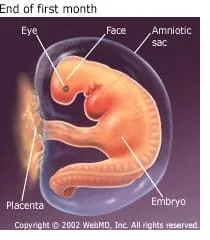
If a sperm cell meets and penetrates an egg, it will fertilize it. This is known as conception. At this moment, the genetic make-up is complete, including the sex of the infant. Within about three days after conception, the fertilized egg, which is dividing rapidly into many cells, passes through the fallopian tube into the uterus where it attaches to the uterine wall. The plancenta, which will nourish the baby, also begins to form.
Fetal development at 12 weeks
The fetus measures about two and a half inches and starts to make its own movements. You will start to see the top of the uterus above the pelvic bone. Your doctor may hear the baby's heartbeat with special instruments. The sex organs of the baby should start to become clear.
Fetal development at 16 weeks
The fetus now measures about 4.3 to 4.6 inches and weighs about 2.8 ounces. The top of your uterus should be felt about three inches below your belly button. The baby's eyes can blink and the heart and blood vessels are fully formed. The baby's fingers and toes should have fingerprints.
Time for an Ultrasound
An ultrasound is generally performed for all pregnant women at 20 weeks of gestation. During this ultrasound, the doctor will confirm that the placenta is healthy and attached normally and that your baby is growing properly in the uterus. The baby's heartbeat and movement of its body, arms, and legs can also be seen on the ultrasound. The gender of the baby can usually be determined at 20 weeks.
Fetal development at 28 weeks
The fetus weighs about 2 pounds 6 ounces. It changes position frequently at this point in pregnancy. There's a good chance of survival if your baby was born prematurely now. Ask your doctor about preterm labor warning signs. Register for birthing classes. Birthing classes prepare you for many aspects of childbirth, including labor and delivery and parenting the newborn.
Fetal development at 32 weeks
Often on the move, the fetus weighs almost 4 pounds. The baby's skin has less wrinkles as a layer of fat starts to form under the skin. It will gain up to half its birth weight between now and delivery. Ask your doctor how to do a fetal movement chart. Think about breastfeeding. Soon you may start leaking colostrum from your breasts, a yellowish fluid that precedes milk production.
Fetal development at 36 weeks
Babies differ in size, depending on many factors (such as gender, the number of babies being carried, and size of the parents), so your baby's overall rate of growth is as important as the actual size. On average, it's about 12.5 inches and weighs 5.5 pounds. The brain has been developing rapidly. Lungs are nearly fully developed. The head is usually positioned down into the pelvis by now. A pregnancy is considered 'at term' once 37 weeks has been completed; baby is ready!
Birth!
A mother's due date marks the end of her 40th week. A pregnancy begins with implantation and the delivery date can be calculated using the first day of the last period. Based on this, pregnancy can last between 38 and 42 weeks with a 'full term' delivery occurring around 40 weeks. Some post-term pregnancies – those lasting more than 42 weeks – are not truly post-term. A common "cause" is an incorrect due date. For safety reasons, most babies are delivered by 42 weeks, inducing labor if necessary.
Advertisement
Reviewed by Brunilda Nazario, MD on March 19, 2008
IMAGES PROVIDED BY:
(1) Copyright © LookatSciences / Phototake – All rights reserved.
(2) Dr. David M. Phillips / Visuals Unlimited / Getty Images
(3) 3D4Medical.com / Getty Images
(4) Copyright © Scott Camazine / Phototake -- All rights reserved.
(5) Copyright © LookatSciences / Phototake – All rights reserved.
(6) Nestle / Petit Format / Photo Researchers, Inc.
(7) Petit Format / Photo Researchers, Inc.
(8) a) Dr.Benoit/Mona Lisa. Copyright © LookatSciences / Phototake -- All
rights reserved. b)Vincenzo Lombardo / Photographer's Choice / Getty
Images
(9) Dr. Benoit/Mona Lisa. Copyright © LookatSciences / Phototake -- All rights
reserved.
(10) Copyright Dr. Najeeb Layyous / Photo Researchers, Inc.
(11) Jose Manuel Gelpi Diaz / iStockphoto
(12) ICAM/Mona Lisa,. Copyright © LookatSciences / Phototake -- All rights
reserved.
(13) © Yoav Levy / Phototake -- All rights reserved.
REFERENCES:
WebMD: “Your Pregnancy Week by Week.”
WebMD tool: “Fetal Development Timeline.”
WebMD medical reference: “The Good, the Bad, and the Ugly: The Third
Trimester.”
WebMD medical reference: “Prenatal Ultrasound.” Mayo Clinic web site.
This tool does not provide medical advice. See additional information: 
THIS TOOL DOES NOT PROVIDE MEDICAL ADVICE. It is intended for general informational purposes only and does not address individual circumstances. It is not a substitute for professional medical advice, diagnosis or treatment and should not be relied on to make decisions about your health. Never ignore professional medical advice in seeking treatment because of something you have read on the WebMD Site. If you think you may have a medical emergency, immediately call your doctor or dial 911.
© 2008 WebMD, LLC. All rights reserved.
ADD/ADHD|Allergies|Alzheimer's Disease|Anxiety Disorders|Arthritis|Asthma|Back Pain|Balance|Bipolar Disorder|Cancer|Cholesterol |Cold & Flu|Dental Health
Depression|Diabetes|Diet & Weight Loss|Fitness|Food & Cooking|Genital Herpes|Heart Health|Heartburn/GERD |Hypertension|IBS|Incontinence|Menopause
Migraines|Osteoporosis|Parenting|Pregnancy|Sex & Relationships |Sexual Conditions|Skin & Beauty|Skin Problems|Sleep Disorders|Stroke|All Health Topics
Health Services: Today's News|Find a Doctor| Find a Hospital| Symptom Checker| Pill Identifier|Health Care Services|WebMD Health Manager|WebMD Weight Loss Clinic
HLTH Corporation|WebMD Corporate|eMedicine®|Medscape®|MedicineNet®|RxList®|WebMD The Magazine