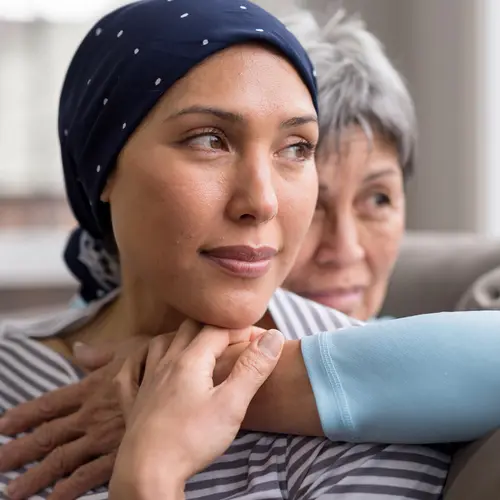
What Is Breast Cancer?
Breast cancer is when the cells under one or both breasts grow out of control. Those cells may spread beyond your breasts. When that happens, the cancer is called metastatic.
Breast cancer usually begins either in your glands that make milk (called lobular carcinoma) or the ducts that carry it to the nipple (called ductal carcinoma). It can grow larger in your breast and spread to nearby lymph nodes or through your bloodstream to other organs. The cancer may grow and invade tissue around your breast, such as your skin or chest wall.
Breast Cancer Symptoms
A lump under the breast, which you may or may not feel, is usually the first sign of breast cancer. When you get a mammogram, your doctor may notice this lump. You also may not notice any signs in the early stages.
The symptoms of breast cancer can include:
- A lump or thickened area in or near your breast or underarm that lasts through your period
- A mass or lump, even if it feels as small as a pea
- A change in your breast’s size, shape, or curve
- Nipple discharge that can be bloody or clear
- Changes in the skin of your breast or your nipple. It could be dimpled, puckered, scaly, or inflamed.
- Red skin on your breast or nipple
- Changes in the shape or position of your nipple
- An area that’s different from any other area on either breast
- A hard, marble-sized spot under your skin
Types of Breast Cancer
Some of the most common types of breast cancer include:
In situ cancers. These types haven't spread past the duct or lobule where they started.
- Ductal carcinoma in situ (DCIS). This is ductal carcinoma in its earliest stage (stage 0). In this case, the disease is still in the milk ducts. But if you don’t treat this type, it can become invasive. It’s often curable.
- Lobular carcinoma in situ (LCIS). This is found only in the lobules, which produce breast milk. It isn't a true cancer, but it means you’re more likely to get breast cancer later. If you have it, get regular breast exams and mammograms.
Invasive cancers. These have spread or invaded the surrounding breast tissue.
- Invasive or infiltrating ductal carcinoma (IDC). This cancer starts in the milk ducts. It breaks through the wall of the duct and invades the fatty tissue of the breast. It’s the most common form, accounting for 80% of invasive cases.
- Invasive lobular carcinoma (ILC). This cancer starts in the lobules but spreads to surrounding tissues or other body parts. It accounts for about 10% of invasive breast cancers. Subtypes of this invasive breast cancer include:
- Adenoid cystic (or adenocystic) carcinoma. These are similar to cells found in your salivary glands and saliva.
- Low-grade adenosquamous carcinoma (a type of metaplastic carcinoma). This rare tumor is usually slow-growing and often mistaken for other types.
- Medullary carcinoma. The tumors in this rare type are a soft, squishy mass that looks like part of your brain called the medulla.
- Mucinous carcinoma. Tumors in this rare type float in a pool of mucin, part of the slippery, slimy stuff that makes up mucus.
- Papillary carcinoma. Fingerlike projections set these tumors apart. This rare type usually affects women who’ve been through menopause.
- Triple-negative breast cancer. This type happens when the cancer cells don't have the right hormonal receptors. It makes up almost 15% of all breast cancers. It can happen at any age, but generally in women under 40.
- Tubular carcinoma. The tumors are slow-growing and tube-shaped.
Less common types include:
- Inflammatory breast cancer. This rare type is caused by inflammatory cells in lymph vessels in your skin.
- Paget's disease of the nipple. This type affects the areola, the thin skin around your nipple.
- Phyllodes tumors of the breast. These rare tumors grow in a leaflike pattern. They grow quickly but rarely spread outside the breast.
- Angiosarcoma. This rare cancer begins in blood or lymph vessels in the breast tissue or in the skin of the breast. It can occur after radiation therapy to an area.
- Metastatic breast cancer. This is cancer that has spread to another body part, like your brain, bones, or lungs.
Breast cancer epidemiology
- Among women, breast cancer is the second most common cancer diagnosed, after skin cancer. It is the second leading cause of cancer deaths, after lung cancer.
- White women get breast cancer at higher rates than women of any other race.
- About two-thirds of women with breast cancer are 55 or older. Most of the rest are between 35 and 54.
- Breast cancer will affect 1 in 8 women in their lifetimes.
- Men can get breast cancer, too, but they only account for less than 1% of all cases.
- About 300,000 cases of breast cancer are reported annually in the U.S.
- More than 40,000 Americans die of breast cancer each year, accounting for around 7% of all cancer-related deaths.
Causes and Risk Factors
Experts don’t know what causes breast cancer, but certain things make you more likely to get it. Your age, genes, personal health history, and diet all play a role. Some you can control. Others you can’t.
Breast Cancer Risk Factors You Can’t Control
- Age. Women over 50 are more likely to get breast cancer than younger women.
- Race: Black women are more likely than White women to get breast cancer before menopause.
- Dense breasts. If your breasts have more connective tissue than fatty tissue, it can be hard to see tumors on a mammogram.
- Personal history of cancer. Your odds go up slightly if you have certain benign breast conditions. They go up more sharply if you’ve had breast cancer before.
- Family history. If a first-degree female relative (mother, sister, or daughter) had breast cancer, you’re two times more likely to get the disease. Having two or more first-degree relatives with a history of breast cancer increases your risk at least three times. This is especially true if they got cancer before menopause or if it affected both breasts. The risk can also rise if your father or brother was diagnosed with breast cancer.
- Genes. Changes to two genes, BRCA1 and BRCA2, are responsible for some cases of breast cancer in families. About 1 in 200 women have one of these genes. While they make you more likely to get cancer, they don’t mean you definitely will. If you have a BRCA1 or BRCA2 mutation, you have a 7 in 10 chance of being diagnosed with breast cancer by age 80. These genes also raise your odds of ovarian cancer, and they’re linked to pancreatic cancer and male breast cancer. Other gene mutations linked to breast cancer risk include mutations of the PTEN gene, the ATM gene, the TP53 gene, the CHEK2 gene, the CDH1 gene, the STK11 gene, and the PALB2 gene. These carry a lower risk for breast cancer development than the BRCA genes.
- Menstrual history. Your breast cancer odds go up if:
- Your periods start before age 12.
- Your periods don’t stop until after you’re 55.
- Radiation. If you had treatment for cancers like Hodgkin's lymphoma before age 40, you have an increased risk of breast cancer.
- Diethylstilbestrol (DES). Doctors used this drug between 1940 and 1971 to prevent miscarriage. If you or your mother took it, your breast cancer odds go up.
Breast Cancer Risk Factors You Can Control
- Physical activity. The less you move, the higher your chances.
- Weight and diet. Being overweight after menopause raises your odds.
- Alcohol. Regular drinking – especially more than one drink a day – increases the risk of breast cancer.
- Reproductive history.
- You have your first child after age 30.
- You don’t breastfeed.
- You don’t have a full-term pregnancy.
- Taking hormones. Your chances can go up if you:
- Use hormone replacement therapy that includes both estrogen and progesterone during menopause for more than 5 years. This increase in breast cancer risk returns to normal 5 years after you stop treatment.
- Use certain birth control methods, including birth control pills, shots, implants, IUDS, skin patches, or vaginal rings that contain hormones
Still, most women who are at high risk for breast cancer don’t get it. On the other hand, 75% of women who develop breast cancer have no known risk factors.
Breast Cancer Diagnosis
If you feel a lump or if something shows up on a mammogram, your doctor will begin the breast cancer diagnosis process.
They’ll ask about your personal and family health history. Then, they’ll do a breast exam and order tests that include:
Imaging tests. Your doctor will use these to learn more about your breast.
- Ultrasound. This test uses sound waves to make a picture of your breast.
- Mammogram. This detailed X-ray gives doctors a better view of lumps and other problems.
- Magnetic resonance imaging (MRI). This body scan uses a magnet linked to a computer to create detailed images of the insides of your breasts.
- Biopsy. For this test, the doctor removes tissue or fluid from your breast. They look at it under a microscope to check for cancer cells and, if they’re there, learn which type they are. Common procedures include:
- Fine-needle aspiration. This is for easy-to-reach lumps or those that might be filled with fluid.
- Core-needle biopsy. This type uses a bigger needle to remove a piece of tissue.
- Surgical (open) biopsy. A surgeon removes the entire lump along with nearby breast tissue.
- Lymph node biopsy. The doctor removes a part of the lymph nodes under your arm to see if the cancer has spread.
- Image-guided biopsy. The doctor uses imaging to guide the needle.
The doctor can test your biopsy sample for:
- Tumor features. Is it invasive or in situ, ductal, or lobular? Has it spread to your lymph nodes? The doctor also measures the margins or edges of the tumor and their distance from the edge of the biopsy tissue, which is called margin width.
- Estrogen receptors (ER) and progesterone receptors (PR). This tells the doctor if the hormones estrogen or progesterone make your cancer grow. This affects how likely it is that your cancer will come back and what type of treatment is most likely to prevent that.
- HER2. This test looks for the gene human epidermal growth factor receptor 2. It can help cancer grow more quickly. If your cancer is HER2-positive, targeted therapy could be a treatment option for you.
- Grade. This tells the doctor how different the cancer cells look from healthy cells and whether they seem to be slower-growing or faster-growing.
- Oncotype Dx. This test evaluates 16 cancer-related genes and five reference genes to estimate the risk of the cancer coming back within 10 years of diagnosis.
- Breast Cancer Index. This test can help your doctor decide how you need endocrine therapy.
- MammaPrint. This test uses information from 70 genes to predict the risk of the cancer coming back.
- PAM50 (Prosigna). This test uses information from 50 genes to predict if the cancer will spread.
You might get blood tests including:
- Complete blood count (CBC). This measures the number of different types of cells, like red and white blood cells, in your blood. It lets your doctor know if your bone marrow is working the way it should.
- Blood chemistry. This shows how well your liver and kidneys are working.
- Hepatitis tests. Doctors sometimes do these to check for hepatitis B and hepatitis C. If you have an active hepatitis B infection, you may need medication to fight the virus before you get chemotherapy. Without it, chemo can cause the virus to grow and damage your liver.
Find out more on the tests and biopsy for breast cancer diagnosis here.
Breast Cancer Stages
- Early stage, stage 0, or noninvasive breast cancer. The disease is only in the breast, with no signs that it’s spread to the lymph nodes. (Your doctor will call this carcinoma in situ.)
- Stage I breast cancer. The cancer is 2 centimeters or less in size and hasn't spread.
- Stage IIA breast cancer. The tumor is either:
- Smaller than 2 centimeters across, with underarm lymph node involvement
- Larger than 2 but less than 5 centimeters across, without lymph node involvement
- Stage IIB breast cancer. A tumor that’s either:
- Larger than 5 centimeters across, without underarm lymph node involvement
- Larger than 2 but less than 5 centimeters across, with lymph node involvement
- Stage IIIA breast cancer or locally advanced breast cancer, either:
- A tumor larger than 5 centimeters that has spread to the lymph nodes under the arm or near the breastbone
- Any size tumor with cancerous lymph nodes that stick to one another or nearby tissue
- Stage IIIB breast cancer. A tumor of any size that has spread to the skin or chest wall
- Stage IIIC breast cancer. A tumor of any size that has spread farther and involves more lymph nodes
- Stage IV (metastatic) breast cancer. A tumor, regardless of size, that has spread to places far away from the breast, such as bones, lungs, liver, brain, or distant lymph nodes
Breast Cancer Treatment
If the tests find breast cancer, you and your doctor will create a treatment plan to get rid of the cancer. This can lower the odds that it will come back and reduce the chance of it moving outside your breast. Treatment generally follows within a few weeks after the diagnosis.
Your treatment will depend on the size and location of the tumor, the results of lab tests on the cancer cells, and the stage of the disease. Your doctor usually considers your age and general health as well as your feelings about the treatment options.
Local treatments
These remove, destroy, or control the cancer cells in a specific area, such as your breast. These include:
Surgery
- Breast-conserving surgery. The surgeon removes only the part of the breast with the cancer, along with some nearby tissue. How much they take out depends on things like the size and location of the tumor. You might also hear it called:
- Lumpectomy
- Quadrantectomy
- Partial mastectomy
- Segmental mastectomy
- Surgery to remove lymph nodes. Your doctor might take lymph nodes from under your arm to find out whether cancer has spread to them. There are two kinds of this surgery:
- Sentinel lymph node biopsy. The doctor removes one or a few lymph nodes where cancer is most likely to spread.
- Axillary lymph node dissection. This involves more nodes, though usually fewer than 20.
- Mastectomy. A surgeon removes the entire breast, along with all of the breast tissue and sometimes nearby tissues. There are several types of mastectomies:
- Simple or total mastectomy. The surgeon removes your entire breast, but not the lymph nodes under your arm unless they’re within breast tissue.
- Modified radical mastectomy. The surgeon removes your entire breast along with lymph nodes under your arm.
- Radical mastectomy. The surgeon removes your entire breast and lymph nodes under your arm and up to your collarbone, as well as the chest wall muscles under your breast.
- Partial mastectomy. The surgeon removes the cancerous breast tissue and some tissue nearby – usually more than in a lumpectomy.
- Nipple-sparing mastectomy. The surgeon removes all the breast tissue but leaves your nipple alone.
- Contralateral prophylactic mastectomy. If you have cancer in one breast and a very high risk of getting it in the other breast, you might choose to have both breasts removed.
Know more about breast cancer surgery options.
Radiation. Whether you get it and what type depend on the type of surgery you had, if your cancer has spread to the lymph nodes or somewhere else in your body, the size of your tumor, and, sometimes, your age. You might have one type or a combination:
- External beam radiation. This type comes from a machine outside your body. You generally get it 5 days a week for 5 to 6 weeks. Some types of external beam radiation include:
- Hypofractionated radiation therapy. You get larger doses using fewer treatments, typically only 3 weeks.
- Intraoperative radiation therapy (IORT). In this approach, you get a single large dose of radiation in the operating room right after breast conservation surgery (before the wound is closed).
- 3D-conformal radiotherapy. You get radiation from special machines that can better aim it at the area where the tumor was. You’ll get treatments twice a day for 5 days.
- Internal radiation (brachytherapy). In this type, your doctor puts something radioactive inside your body for a short time.
- Interstitial brachytherapy. The doctor inserts several small, hollow tubes called catheters into the breast around the area where the cancer was. They stay in place for several days. Doctors put radioactive pellets into them for short periods every day.
- Intracavitary brachytherapy. This is the most common type of brachytherapy for women with breast cancer. The doctor uses a small catheter to put a device inside your breast. The device is widened and stays in place during the treatment. The other end sticks out of the breast. The doctor uses a tube to put radiation sources (often pellets) into the device. You usually get this twice a day for 5 days as an outpatient. After the last treatment, the doctor collapses the device and removes it.
Learn more about radiation therapy for breast cancer.
Systemic treatments
They destroy or control cancer cells all over your body. These treatments include:
- Chemotherapy. You might take these drugs as pills or get them injected into a vein. It might be your main treatment if you have advanced breast cancer. Or you could get it before surgery (neoadjuvant chemotherapy) or after surgery (adjuvant chemotherapy). Read more on chemotherapy to treat breast cancer.
- Hormone therapy. Some cancers grow in response to certain hormones. These medications stop the hormones from attaching to cancer cells, which stops their growth.
Selective estrogen receptor modulators (SERMs):
- Tamoxifen
- Toremifene (Fareston)
Selective estrogen receptor degraders (SERDs):
- Elacestrant (Orserdu)
- Fulvestrant (Faslodex)
Aromatase inhibitors:
- Anastrozole (Arimidex)
- Exemestane (Aromasin)
- L+etrozole (Femara)
Luteinizing hormone-releasing hormone (LNRH) agonists:
- Goserelin (Zoladex)
- Leuprolide (Lupron)
Get more details on hormone therapy for breast cancer treatment.
- Targeted drugs. These drugs stop the changes that make cells grow out of control.
Monoclonal antibodies:
- Ado-trastuzumab emtansine (Kadcyla)
- Fam-trastuzumab deruxtecan (Enhertu)
- Margetuximab (Margenza)
- Pertuzumab (Perjeta)
- Sacituzumab govitecan (Trodelvy)
- Trastuzumab (Herceptin)
- Trastuzumab and hyaluronidase injection (Herceptin Hylecta)
- Trastuzumab, pertuzumab, and hyaluronidase injection (Phesgo)
Kinase inhibitors:
- Lapatinib (Tykerb)
- Neratinib (Nerlynx)
- Tucatinib (Tukysa)
CDK4/6 inhibitors:
- Abemaciclib (Verzenio)
- Palbociclib (Ibrance)
- Ribociclib (Kisqali)
mTOR inhibitor:
- Everolimus (Afinitor)
PI3K inhibitor:
- Alpelisib (Piqray)
PARP inhibitors:
- Olaparib (Lynparza)
- Talazoparib (Talzenna)
Immunotherapy. Medications such as pembrolizumab (Keytruda) a PD-1 Inhibitor, help your immune system fight cancer.
Find out the pros and cons of immunotherapy to treat cancer.
Breast Cancer Disparities
White women in the U.S. have the highest rates of breast cancer among all races and ethnicities, just ahead of Black women. But Black women are 40% more likely to die from their breast cancers, compared to White women. This disparity stems from many factors. One reason is that Black women on average get diagnosed with breast cancer at earlier ages, and with more aggressive types, compared to other groups. Among other explanations are poverty, lack of insurance, obesity, and dense breasts.
Asian, Hispanic, and Native American women in the U.S. have lower rates of breast cancer than both White and Black women, and also are less likely to die from it.
Breast Cancer Prevention
These tips may help you prevent breast cancer:
- Control your weight. Extra pounds and weight gain as an adult raise your odds for breast cancer after menopause.
- Stay active. Exercise lowers your risk. Aim for 150 minutes of moderate or 75 minutes of heavy activity each week (or a mix). Spread it out during the week.
- Limit or skip alcohol. Experts recommend that women have no more than one alcoholic drink a day. That’s 12 ounces of beer, 5 ounces of wine, or 1.5 ounces of 80-proof distilled spirits (hard liquor).
- Breastfeed. Longer is better to lower your risk.
- Limit hormone therapy after menopause. Ask your doctor about non-hormonal options to treat your symptoms.
- Get screened. Recommendations vary by age and risk and other factors. Some of the most recent include:
- U.S. Preventive Services Task Force:
- 40-49: Get a mammogram every 2 years if you and your doctor think you need it.
- 50-74: Get a mammogram every 2 years.
- 75+: Ask your doctor if you should continue getting mammograms.
- American Cancer Society:
- 40-44: Get an annual mammogram if you and your doctor think you need it.
- 45-54: Get an annual mammogram.
- 55-74: Get a mammogram every 1 or 2 years.
- 75+: Get a mammogram every year so long as you’re in good health and are expected to live 10 years or more.
- U.S. Preventive Services Task Force:
Learn more about mammogram to detect breast cancer.
Management if you’re at high risk
If you have one of the risk factors for breast cancer, talk to your doctor about some things that may help lower your odds. These include:
- Genetic testing to look for a change in your genes that raises your risk
- More frequent doctor visits and screening tests
- Medicines such as raloxifene, tamoxifen, and aromatase inhibitors
- Surgery to remove your breasts or ovaries
Breast Cancer Prognosis
Your outlook after breast cancer depends on many things, including your cancer stage at the time of diagnosis.
- Nearly 99% of women whose cancer is only in their breast and hasn't spread to other body parts live at least 5 years after diagnosis.
- If a woman’s breast cancer spreads to nearby lymph nodes, the 5-year survival rate is closer to 86%.
- If the cancer spreads to other parts of the body, like the lungs, liver, and bones, the chance of living at least 5 more years is 31%.
Get more information on breast cancer survival rates.
For anyone who's had breast cancer, there's a chance that some breast tissue cells still in the body can start to multiply and become cancerous. The chances are different for every person. The cancer can come back in the same area (local recurrence) or in another part of the body away from the breast area (regional and distant recurrence). Even if it's far away from the breasts, it's still breast cancer. The signs and symptoms of recurrent breast cancer can depend on where it comes back.
Your doctor will check for signs that your cancer has come back at your follow-up exams after treatment. If it does come back, they'll make a plan to treat it right away. It will likely be different from the type of treatment you had the first time, depending on where it is, what type it is, what specific treatments you had before, and your overall health.
Takeaways
Breast cancer can happen for reasons beyond your control, such as your age and genes. It can also come from factors that you can change, including keeping a healthy weight and getting recommended screening. Your actions can help to both prevent breast cancer and make it more treatable.