What Is Colorectal Cancer?
Inside your abdominal cavity is the long, tubular digestive tract. The second part of this tube -- the large intestine -- is composed of the colon, which stretches 4 feet to 6 feet, and the rectum, which is only 4 inches to 6 inches long.
The inner lining of this "colorectal tube" can be a fertile breeding ground for small tumors, called polyps (Figure 1). About a quarter of all adults in the U.S. older than age 50 will have at least one colorectal polyp. Most colorectal cancers develop from polyps in glandular tissue of the intestinal lining.
Most polyps are benign, but at least one type is known to be precancerous. These are called adenomatous polyps.
The size of the polyp correlates with the development of cancer. Polyps less than 1 centimeter in size have a slightly greater than a 1% chance of becoming cancer, but those 2 centimeters or greater have a 40% chance of transforming into cancer. Overall, the incidence is about 5%. Most colorectal cancers develop from polyps in glandular tissue of the intestinal lining.
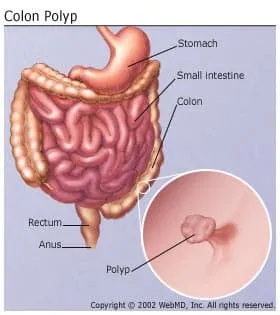
If colorectal cancer is diagnosed and treated early while the tumor is still localized, the disease is highly curable, with five-year survival rates of about 90%. If the tumor continues to grow, cancer can spread directly through the bowel wall to surrounding lymph nodes, tissues, and organs, as well as into the bloodstream.
Once the cancer spreads to lymph nodes or other organs, successful treatment becomes more difficult. Depending on how advanced the disease is, five-year survival rates range from 11% to 72%.
Cancers of the colon and rectum are common, with approximately 106,590 cases diagnosed each year. Like many cancers, colorectal cancer is of particular concern for people older than age 50.
Although diagnosis is often possible at an early stage, many people delay seeking medical care because they are embarrassed or fearful of symptoms related to their bowels. Risk increases significantly after age 50 and continues to increase with age.
What Causes Colorectal Cancer?
The exact cause of colorectal cancer is not known. But there are several risk factors for the disease.
- Other diseases. Colorectal cancer is strongly associated with certain other diseases. Those people considered at high risk include anyone with a personal or family history of colon polyps or colon cancer, inflammatory diseases of the colon such as ulcerative colitis or Crohn's disease, and cancers of the pancreas, breast, ovaries, or uterus.
- Heredity. As with any cancer, susceptibility to colorectal cancer is at least partly determined by genetic makeup. A few people inherit medical conditions, such as familial adenomatous polyposis (FAP), MYH-associated polyposis (MAP), Gardner's syndrome, Turcot's syndrome, Peutz-Jagher's syndrome, juvenile polyposis, and Cowden's disease. In all of these disorders, colon polyps develop at an early age, and unless treated, these people are at high risk of developing colorectal cancer.
- Hereditary nonpolyposis colon cancer. The disease extends from generation to generation and causes a person to develop colon cancer. This disease is associated with other cancers including endometrial, ovarian, stomach, small intestine, pancreas, kidney, ureter, brain, and bile duct.
- Diet. Diet also contributes to the risk of colorectal cancer, although the cause-and-effect relationship is still unclear. People whose diets are high in fruits and vegetables seem to have a reduced risk. Many studies implicate animal fat and protein as promoters of colorectal cancer, although researchers are cautious about drawing any definite conclusions. Some studies show that regularly eating red meat, which is rich in saturated fat and protein, increases risk, while others find no connection. Some scientists note that fat is the main culprit, while others suspect protein. Others contend that it's not the fat and protein themselves, but the way they are cooked. They note that fats and protein cooked at high temperatures -- especially when broiled and barbecued -- can produce a host of potentially carcinogenic substances linked to colorectal cancer.
- Chemical exposure. Heavy exposure to certain chemicals, including chlorine -- which in small amounts is commonly used to purify drinking water -- may increase the risk of colorectal cancer. Exposure to asbestos is thought to be potentially harmful because it has been implicated in causing the formation of polyps in the colon.
- History of certain types of surgery. Surgeries such as ureterosigmoidostomy, which is performed in the treatment of bladder cancer, and a cholecsytecomy (the removal of the gallbladder). Some studies show surgery of the bladder may lead to a risk for colon cancer development, but other studies do not.
- History of colon cancer. A prior case of colon cancer increases the risk of a second colon cancer, especially if the first cancer was diagnosed before the age of 60.
- Lifestyle. Smoking and alcohol intake of more than 4 drinks per week increases the risk of developing colon cancer.
- Family history. Those with a first-degree relative with colorectal cancer have an increased risk of the disease. The risk increases if more than one first-degree relative has colon cancer.
- Radiation. Prior radiation increases the risk of cancer to the radiated tissue only.