With spring nearly upon us, and warmer weather not far behind, you probably can't wait to convert your stuffy indoor fitness routine into breezy outdoor fun. Even if you've never exercised before, adding physical activity to your life can seem a lot more appealing when Mother Nature is your workout partner.
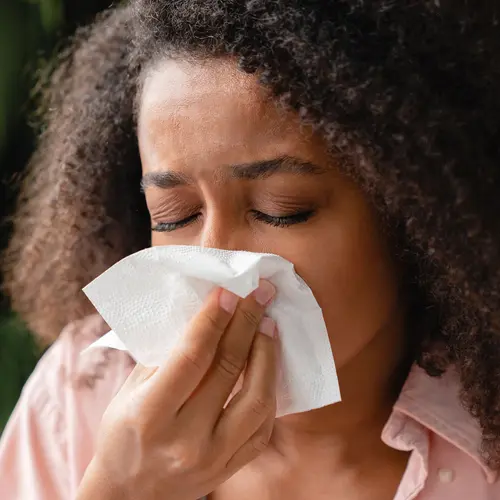
Unfortunately, if you're one of the tens of thousands who also suffer with seasonal allergies sometimes called "hay fever "just the thought of doing anything in the pollen-rich spring and summer air can set your sneezing, wheezing, runny nose, and itchy watery eyes in motion.
If this is the case for you, don't despair. Allergists say you can safely turn your exercise routines "inside-out" -- without sacrificing allergy relief. The first rule of seasonal survival: Avoid activities that increase the impact of a high pollen count.
"Any exercise that involves a high degree of movement and significantly increases your respiratory rate could cause problems," says Chicago allergist Brian Smart, MD, spokesman for the American Academy of Allergy, Asthma, and Immunology (AAAAI).
That's because the faster you move through air, says Smart, the more airborne pollens and mold spores strike your face, and are inhaled -- and ultimately the greater your chance of an allergic reaction. The activities to avoid -- particularly on days when the pollen count is high and symptoms are flaring -- include running, jogging, biking, or team ball sports.
"Workouts that are a lot more" allergy friendly" include yoga, swimming, Tai Chi, stretching, weight training -- activities which don't involve a lot of huffing and puffing," says allergist Gillian Shepherd, MD, professor of medicine at Weil Medical College of Cornell University.
If, in fact, you just can't live without your daily run or bike ride, Smart tells WebMD to plan workouts when pollen counts are at their lowest. Pollen concentrations are usually highest between 5 a.m. and 10 a.m., according to the American Academy of Allergy, Asthma, and Immunology.
Weather Is Key
The pollen seasons for particular plants are very consistent within each geographical region. Weather plays a large role in determining what the pollen count will be, both seasonally and daily. A change in temperature, wind conditions, humidity, or precipitation can change the pollen counts.
Usually, pollen counts are highest on warm, dry, and breezy mornings and lowest on rainy, cooler days. The severity of your allergic reaction will generally mirror the rise and fall of the pollen count.
What can also make a difference is discovering your personal pollen tolerance level -- the point at which yourallergy symptoms kick in. How can this help? Pollen counts are tabulated by the number of pollen grains in a cubic meter of air. While experts say some people can be affected when a tree pollen count is as low as 15 for example, others might not experience symptoms until the count hits 1,500 or above.
To discover what your personal tolerance level is, Shepherd says monitor the pollen levels and keep track of the point at which you begin to experience symptoms. Then use that information, along with daily pollen counts, to plan activities when and where you are least likely to experience problems.
Now if you're thinking that all you need do to eliminate symptoms is choose a workout site that is void of grass and trees, guess again.
"Pollen can travel miles, so theoretically you could jog on the deck of a cruise ship and still have pollen symptoms," says allergist Kathleen Sheerin, MD, head of the Public Education committee of the AAAAI.
That said, allergist Christopher Randolph, MD, tells WebMD that the farther you are from the source of the pollen the better you are likely to feel. So, while you may not be able to completely avoid allergic symptoms, you can significantly cut down on the severity by choosing your locations wisely.
"An asphalt tennis court would be better than a grassy terrain, while exercising on the beach may produce fewer symptoms than working out in a heavily wooded area," says Randolph, associate clinical professor of medicine at Yale University School of Medicine.
Later Rather Than Sooner
Although exercising outdoors can increase your contact with pollen, ironically, the extra adrenalin your body produces while you are working out can temporarily dampen the allergic response. This, says Shepherd, in combination with the actual time it takes for contact with pollen to incite an allergic reaction -- about an hour -- means your worst symptoms might not occur while you are exercising at all, but after you stop.
To reduce your risk of allergies after outdoor workouts, experts say always take a shower, wash your hair and put on clean clothes immediately after working out to eliminate further contact with pollen.
In addition, don't forget the power of allergy medications to make outdoor activity more pleasurable. In fact, Randolph tells WebMD that with the proper medication nearly everyone with seasonal allergies can enjoy the great outdoors without fear. For best results, however, experts say take your medications on a regular basis, so you are fully protected when you do go outside. If you normally use medication only when you know you will be exposed to an allergen, Sheerin says take it at least one hour before you plan your outdoor workout. Nasal steroid sprays should be started 24 hours before a planned exposure.
Finally, it's also important to remember that if your seasonal allergies are severe, you may have to limit your time outdoors -- to times when pollen counts are at their lowest -- or keep all your workouts indoors, particularly on days when pollen counts are high, and it's warm and windy.
If, in fact, you do want to try and spend more time outdoors, our experts offer the following additional tips for reducing allergy symptoms.
- If itchy, watery eyes are a problem, wear goggles, or wrap around sunglasses when exercising outdoors -- and don't forget the power of eye drops, used about an hour before you go outside. If you find your eyes itch after going to bed, or when you wake, change your pillowcase daily, and be certain to wash hair before hitting the sheets at night.
- For activities that involve heavy breathing (such as running or bike racing) a light paper face filter may help reduce pollen intake.
- Use a saline nasal spray to clear the nose of excess pollen after you finish exercising.
- Avoid exercising outdoors if you are run down, tired, jet lagged, or stressed, since your immune system is likely to react more swiftly and severely to an allergen. Women with seasonal allergies should avoid exercising outdoors during their menstrual cycle, since the body may be slightly more sensitive to allergens during this time.
- If you are beginning a fitness program, and allergies are moderate to severe, exercise indoors for several weeks to help condition your body, before moving activities outdoors.
- Be aware of oral allergy syndrome -- a cross reaction between what you eat and the pollen count outside. If you are allergic to birch trees for example, eating apples, cherries, peaches, plums or celery seed, before or after working out, might intensify allergy symptoms. Other possible cross-reactions include chamomile tea, melon, banana, cucumber, and sunflower seeds, which interact with ragweed and other weed pollens.
- After you finish exercising outdoors -- or if allergy symptoms flare -- go inside, shut windows, and if possible put on an air conditioner to clear the air. Remain inside until symptoms subside.
- Learn how to interpret pollen counts, and keep track of the levels in your area. Here is some important information from the American Academy of Allergy, Asthma, and Immunology:
- If pollen counts are low only individuals extremely sensitive to pollen and mold will experience symptoms.
- If pollen counts are moderate many individuals sensitive to these pollens and molds will experience symptoms.
- If pollen counts are very high almost all individuals with any sensitivity at all to these pollens and molds will experience symptoms. Extremely sensitive people could have severe symptoms.