Nasopharyngeal cancer is a rare type of head and neck cancer. It starts in the upper part of your throat, behind the nose. This area is called the nasopharynx.
The nasopharynx is precariously placed at the base of your skull, above the roof of your mouth. Your nostrils open into the nasopharynx. When you breathe, air flows through your nose into your throat and nasopharynx, and eventually into your lungs.
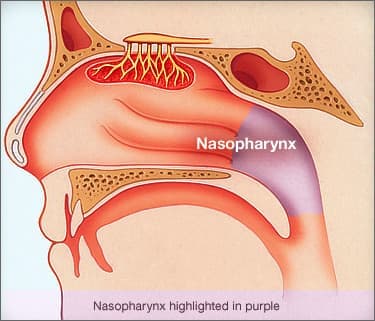
Nasopharyngeal cancer is also called nasopharyngeal carcinoma (NPC).
Causes of Nasopharyngeal Cancer
Scientists are not sure what exactly causes nasopharyngeal cancer. However, the cancer has been strongly linked to the Epstein-Barr virus (EBV).
Although EBV infection is common, not everyone who has EBV will get nasopharyngeal cancer. In the U.S., most people who have had an EBV infection never have long-term problems. Scientists are still researching how EBV leads to nasopharyngeal cancer, but it may be related to genetic material (DNA) from the virus affecting the DNA in the cells of the nasopharynx. The change in DNA causes cells to grow and divide abnormally, causing cancer.
The risk for NPC goes up if you eat a diet rich in salt-cured fish and meat. Tobacco and alcohol may also increase the risk, although their link to NPC is not clear. Some scientists believe that chemicals in these things further damage the DNA in cells.
Who Gets Nasopharyngeal Cancer?
Fewer than one in every 100,000 people in the U.S. gets this type of cancer, according to the American Cancer Society.
The cancer is most common in southern China and southeast Asia. It is also much more common in:
- Other parts of Asia
- North Africa
- Inuit populations of Alaska and Canada
- Chinese and Hmong immigrant groups in the U.S.
In the U.S., nasopharyngeal cancer has also been seen in African-Americans, Hispanics, and white people.
You are more likely to get this type of cancer if you:
- Are male
- Eat a diet rich in salt-cured fish and meats
- Have a family history of nasopharyngeal cancer
- Have certain genes linked to cancer development
- Have come in contact with EBV
Some, but not all, studies have found a higher risk of nasopharyngeal cancer in people who:
- Smoke
- Drink a lot of alcohol
- Work around wood dust or a chemical called formaldehyde
Nasopharyngeal Cancer Symptoms
Symptoms of nasopharyngeal cancer may include:
- Lump in neck (most common)
- Blurry or double vision
- Ear infections that recur
- Face pain or numbness
- Headache
- Hearing loss, ringing in the ears, or a feeling of fullness in the ear
- Difficulty opening mouth
- Nosebleeds
- Stuffy nose
- Sore throat
Keep in mind, such symptoms are more likely to occur with many other diseases and health conditions that are far less serious than nasopharyngeal cancer.
If you have any of the above symptoms, see your doctor. Only an experienced medical person can diagnose or rule out nasopharyngeal cancer.
How Nasopharyngeal Cancer Is Diagnosed
Your doctor will ask you questions about your symptoms, medical history, and family history, and perform a physical exam. This includes a detailed look at your ears, nose, and throat. You may be sent to a doctor who specializes in these areas, called an otolaryngologist.
The doctor or nurse will also feel your neck. Most patients with nasopharyngeal cancer have a lump in the neck. This is a sign that the cancer is spreading to the lymph nodes.
A flexible, lighted tube may be placed through your mouth or nose to help the doctor better view the nasopharynx. This is called a nasopharyngoscopy. It helps the doctor check the area for abnormal growths, bleeding, or other problems.
If the exam is abnormal, your doctor may recommend a biopsy. A biopsy is the removal of a small amount of tissue for examination under a microscope.
A biopsy may be taken during the nasopharyngoscopy. If there is a lump in your neck, the biopsy may be done by placing a very thin, hollow needle into the lump.
Imaging tests can help spot nasopharyngeal cancer or determine if it has spread. Imaging tests may include:
- Chest X-ray
- CT scan
- MRI
- Ultrasound of the neck
The following tests may also be performed:
- Complete blood count (CBC) and other blood tests
- EBV testing
If you are diagnosed with nasopharyngeal cancer, other tests will be done to determine if and where the cancer has spread. This is called staging.
Nasopharyngeal cancer is staged from Stage 0 (the earliest stage) to Stage IV (the most advanced stage). The lower the number, the less the cancer has spread to other parts of the body.
- Stage 0 is called carcinoma in situ.
- Stage I is early-stage nasopharyngeal cancer that has not spread to lymph nodes or distant parts of the body.
- Stage II is nasopharyngeal cancer that may have spread to nearby tissues and lymph nodes but has not spread to distant parts of the body.
- Stages III and IV are considered more advanced because of tumor size, extent of spread to nearby tissues, lymph nodes, and/or distant parts of the body.
- If nasopharyngeal cancer returns, it is called recurrent cancer.
Nasopharyngeal Cancer Treatment
If you are diagnosed with nasopharyngeal cancer, you will need regular follow-ups with your medical team before, during, and after treatment.
Your treatment will depend on many things, including:
- Location of the tumor
- Stage of the tumor
- Your overall health
Treatment may include:
Radiation Therapy. Radiation therapy uses X-rays to kill cancer cells and stop them from growing. It is usually part of the standard treatment for early stage nasopharyngeal cancer.
One type called IMRT delivers high-dose radiation directly to the tumor while minimizing damage to nearby healthy tissue. It may cause fewer side effects or complications than conventional radiation treatment to the nasopharynx, which can lead to:
- dry mouth
- inflammation of the lining of your mouth and throat
- blindness
- brain stem injury
- death of healthy tissue
- tooth decay
Chemotherapy.Chemotherapy uses drugs to kill cancer cells. By itself, it is not usually helpful for treating nasopharyngeal cancer. But it may help you live longer when combined with radiotherapy or biological drugs.
Surgery. Surgery to remove the tumor is not often performed because of the tumor's location near nerves and blood vessels. It may cause permanent damage to the eye and other nearby structures.
Not all people with nasopharyngeal cancer can have surgery. Your doctor will consider the location and stage of your tumor when discussing your treatment options.
Biologic drugs. Biologic drugs affect how your body's immune system fights disease. They include monoclonal antibodies such as cetuximab (Erbitux), pembrolizumab (Keytruda), and nivolumab (Opdivo). Biologics work differently than chemotherapy drugs and may be used more often in cases of advanced or recurrent cancer.
Palliative therapy. The goal of palliative treatment is to control symptoms related to cancer and cancer treatment and make you as comfortable as possible.
Clinical trials. If treatment does not work, consider joining a clinical trial. Researchers are always testing new ways to treat cancer, and they need your help. Ask your doctor or nurse if there are any clinical trials on nasopharyngeal cancer in your area.
Can Nasopharyngeal Cancer Be Prevented?
Many cases of nasopharygeal cancer are not preventable, but taking these steps may help lower your risk of nasopharyngeal cancer:
- Avoid salt-cured fish and meats.
- Do not smoke.
- Do not drink a lot of alcohol.