Is That Mole Skin Cancer?
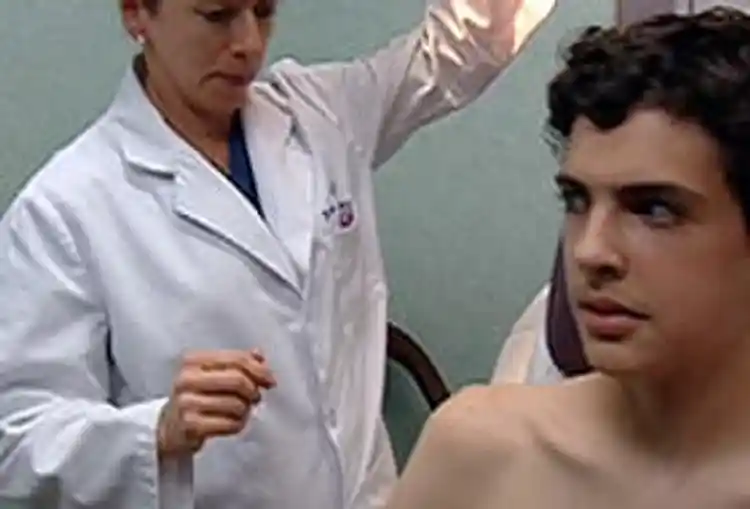
Hide Video Transcript
Video Transcript
Narrator
Five year old Violet Opazo is getting her second coat of sunscreen. She's not allowed outside without it. That wasn't the case when mom Taylor was growing up. She remembers spending hours by the pool without any sunscreen… soaking up the sun's rays…but today… Taylor Opazo
I don't sunbathe at all (laughs). I love being outside, I love working in the garden, but I just can't go hang out at the pool all day, in the water or without any protection at all because I'm afraid… Narrator
Afraid that she might get skin cancer again: During a routine examination, Taylor's dermatologist noticed a suspicious blemish near her hairline. After a biopsy, the lesion was found to be a superficial cancer not unlike basal cell, the most common form of benign skin cancer. The second most common skin cancer is squamous. While neither is deadly they should not be ignored. Harold Brody, MD
The majorities of skin cancers occur in sun exposed areas. And these skin cancers are less likely to be fatal than malignant melanoma, which can be anywhere, but they do occur on areas where people have gotten the most sun and they can be locally destructive. Narrator
Taylor opted to have her spot removed using an outpatient technique known as MOHS micrographic surgery. Benjamin Kelly, MD
Of course the biggest advantage overall is that it's the highest cure rate available. Narrator
Since her surgery, Taylor keeps a close eye on her skin, knowing she has about a 50 percent chance of a reoccurrence. Taylor Opazo
My makeup has sunscreen in it, even if I'm out for 10 minutes at lunch then I'm not worried about burning my face. Narrator
Basil cell and squamous are both slow-growing, but will continue to expand until they are treated. Self-detection is not always reliable so a yearly visit to a dermatologist who can check for skin abnormalities is advised. But for melanoma, the most serious and fast moving form of skin cancer, time is of the essence
Dermatologists have developed a simple acronym — the 'A, B, C, D, E method' — to help you determine if a mole on your skin should be immediately examined by a doctor. 'A' stands for 'asymmetry'. Harold Brody, MD
Asymmetry meaning if your mole…one half looks different than the other half. It's an asymmetric mole and there's a risk. Border: if the border of the mole is blurred. Color
if there's more than just brown. If there's blue or black or red. And diameter: if it's a large mole, say, more than half an inch to an inch in size. Narrator
And 'E' is for evolving — as when a mole or skin lesion changes in size, shape or color. Those most vulnerable will have fair-skin and blue eyes, have had multiple and repeated sunburns, or a family history of skin cancer. Taylor Opazo
You never know. You know a little mole could be something that could kill you. Narrator
If you are in a high risk group you should limit sun exposure and examine your skin once a month in the mirror. For WebMD, I’m Damon Meharg.