Osteoarthritis Health Center
Causes of Osteoarthritis
What causes osteoarthritis?
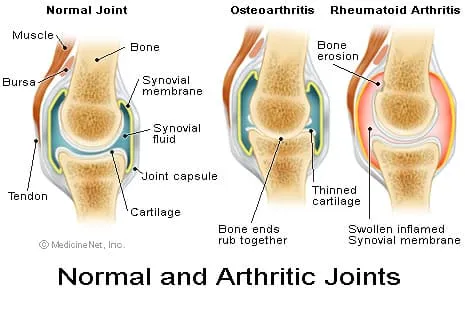
Primary osteoarthritis is mostly related to aging. With aging, the water content of the cartilage increases and the protein makeup of cartilage degenerates. Repetitive use of the joints over the years irritates and inflames the cartilage, causing joint pain and swelling. Eventually, cartilage begins to degenerate by flaking or forming tiny crevasses. In advanced cases, there is a total loss of the cartilage cushion between the bones of the joints. Loss of cartilage cushion causes friction between the bones, leading to pain and limitation of joint mobility. Inflammation of the cartilage can also stimulate new bone outgrowths (spurs) to form around the joints. Osteoarthritis occasionally can be found in multiple members of the same family, implying an heredity (genetic) basis for this condition. Rarely, some of these hereditary cases of osteoarthritis are caused by defects in collagen, which is an important component of cartilage.
Secondary osteoarthritis is caused by another disease or condition. Conditions that can lead to secondary osteoarthritis include obesity, repeated trauma or surgery to the joint structures, abnormal joints at birth (congenital abnormalities), gout, diabetes and other hormone disorders.
Obesity causes osteoarthritis by increasing the mechanical stress on the cartilage. In fact, next to aging, obesity is the most powerful risk factor for osteoarthritis of the knees. The early development of osteoarthritis of the knees among weight lifters is believed to be in part due to their high body weight. Repeated trauma to joint tissues (ligaments, bones and cartilage) is believed to lead to early osteoarthritis of the knees in soccer players. Interestingly, recent studies have not found an increased risk of osteoarthritis in long-distance runners.
Crystal deposits in the cartilage can cause cartilage degeneration, and osteoarthritis. Uric acid crystals cause arthritis in gout, while calcium pyrophosphate crystals cause arthritis in pseudogout.
Some people are born with abnormally formed joints (congenital abnormalities) that are vulnerable to mechanical wear, causing early degeneration and loss of joint cartilage. Osteoarthritis of the hip joints is commonly related to design abnormalities of these joints that had been present since birth.
Hormone disturbances, such as diabetes and growth hormone disorders, are also associated with early cartilage wear and secondary osteoarthritis.
WebMD Medical Reference from MedicineNet
Important Safety Information
Cymbalta® (duloxetine HCl) is approved for the treatment of depression and generalized anxiety disorder, and for the management of diabetic peripheral neuropathic pain and fibromyalgia.
What should I talk about with my healthcare provider?
Patients on antidepressants and their families or caregivers should watch for new or worsening depression symptoms, unusual changes in behavior, thoughts of suicide, anxiety, agitation, panic attacks, difficulty sleeping, irritability, hostility, aggressiveness, impulsivity, restlessness, or extreme hyperactivity. Call your healthcare provider right away if you have thoughts of suicide or if any of these symptoms are severe or occur suddenly. Be especially observant within the first few months of antidepressant treatment or whenever there is a change in dose.
You should also know that:
- Suicide is a known risk of depression and some other psychiatric disorders.
- Antidepressants may increase suicidal thoughts or behaviors in some children, adolescents, and young adults especially within the first few months of treatment or when changing the dose. No increased risk has been shown for adults over age 24, and risk decreased for those over age 65.
- All patients starting therapy should be monitored appropriately and observed closely for new or worsening depression symptoms, suicidal thoughts or behavior, or unusual changes in behavior.
- Cymbalta® is not approved for use in patients under age 18.
Who should NOT take Cymbalta?
You should not take Cymbalta if:
- You have recently taken a type of antidepressant called a monoamine oxidase inhibitor (MAOI)
- You have uncontrolled narrow-angle glaucoma (an eye disease)
- You are taking Mellaril® (thioridazine)
What other important information should I discuss with my healthcare provider?
Before starting Cymbalta, tell your healthcare provider:
- about all of your medical conditions, including kidney problems, glaucoma, or diabetes
- about your alcohol use
- if you are taking nonprescription or prescription medicines, including those for migraine, to address a possible life threatening condition
- if you are taking NSAID pain relievers, aspirin, or blood thinners. Use with Cymbalta may increase bleeding risk
- if you are pregnant, plan to become pregnant during therapy, or are breastfeeding an infant
While taking Cymbalta, tell your healthcare provider:
- if you have itching, right upper belly pain, dark urine, yellow skin/eyes, or unexplained flu-like symptoms, which may be signs of liver problems. Severe liver problems, sometimes fatal, have been reported
- if you have high fever, confusion, and stiff muscles to address a possible life-threatening condition
- before stopping Cymbalta or changing your dose
- if you experience dizziness or fainting upon standing, especially when first starting Cymbalta or when increasing the dose. Your healthcare provider may periodically check your blood pressure while you are taking Cymbalta
If you have any questions, talk to your healthcare provider before taking Cymbalta.
What are the possible side effects of Cymbalta?
The most common side effect of Cymbalta was nausea. For most people who had it, the nausea was mild to moderate. Other common side effects included dry mouth, sleepiness, constipation, decreased appetite, and, increased sweating. This is not a complete list of side effects.