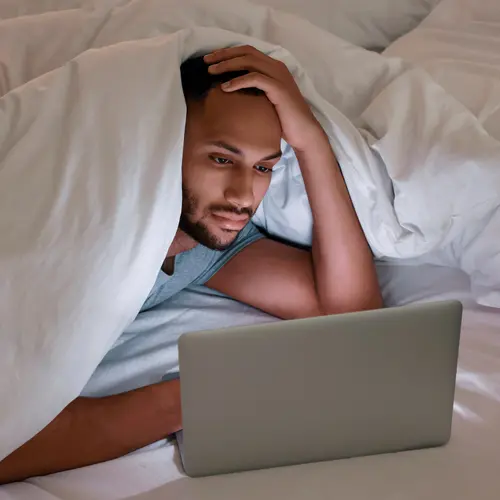
You've spoken publicly about your struggles with insomnia. When did your problems start?
As an actress in my 20s. After my role in Goodfellas and 10 years past that, I was working nonstop. I was jumping from one set to the next. A lot of times we shot at night. I had to be awake at night and a little bit in the day. It became jarring and difficult to do without sleep.
You obviously felt pretty strongly about that, since you decided to be one of the people heading up the "Sleepless Moms" campaign (www.sleeplessmoms.com, sponsored by Takeda Pharmaceuticals) to help the sleep-challenged and those with insomnia.
I was trying to make people aware there's something you can do about it, where you don't have to take a sedative.
Did any other factors contribute to your inability to sleep during this period of your life?
For women in their mid to late 20s and 30s, you start looking for love and start asking, "Am I going to find the right guy?" and "Will I be a mother?" You wonder if it's ever going to happen. Those kinds of thoughts kept me awake.
Why is there such an epidemic of women having problems sleeping?
The world has changed. Women are pretty much expected to work as much as men do, and the mother is sort of the CEO of the house. And the world moves very, very fast, so people are checking their emails at midnight. It's not like the old days, when you could just settle down with a good book and chat with your husband.
Were there physical consequences of your insomnia?
When I don't sleep, I tend to get sick.
What did you eventually do?
I sought a health care professional. My doctor prescribed me sedatives, which really helped me when I was shooting films at night. But I don't like the feeling of being groggy the next day. Now, as a parent, sedatives are not an option for me anymore.
Is there a trickle-down effect when moms are sleep deprived?
When the mother's suffering, the whole house generally tends to not be happy. I think mothers, at the end of the day, are so wound up. I know I create tension in my own home when I don't sleep. I'm agitated, I'm not focused.
Your husband's Italian and you spend time with him there. Do you sleep better in Italy?
I do. We live in Florence, three or four months in the year, five minutes into the hills. It's very relaxing for me and a very good escape. They have those fabulous shutters and walls made of stone. Once you close the shutters, it is so quiet. We're able to take siestas together.
So maybe women can create an Italy in their own minds.
I think it's very important for people to figure out a way to transport themselves. We can't all have the luxury of an Italian place to go to, or to take a vacation. If I hadn't married my husband and have my in-laws there, I would really have to search within myself to find some inner peace, putting daily life behind. I think it's very important for women to sleep, give themselves what they need, take a break, give back to themselves.
Living the good life
What is the best health advice anyone has ever given you?
Always think about taking care of yourself, because health, looks -- the whole package -- won't last forever. The body is sacred and must be treated as such.
What disease or condition would you most like to see eradicated in your lifetime, and why?
Cancer and AIDS. Cancer is very ugly. In terms of AIDS, I've lost approximately half of my wonderful friends to it.
Do you have a personal health philosophy?
A clean life. Trying to remember at the end of the day that it's all about love and family. That's what matters.
If you were recovering in a hospital and you could have anyone, from any era, recovering next to you, who would it be?
Someone I'd have fun with.
Name the first time a health condition altered your daily living.
I broke my foot skiing and had to hobble around.
How has being a parent changed you?
I never realized the amount of love I could possibly feel, so it's warmed my heart. It's made me grow as a woman and human being. I have more compassion for other people. The biggest lesson I've learned is patience.
What do you do for relaxation?
I travel and read. Reading is a luxury these days. I like biographies and I also like to lose my mind in fiction.
What is your best health habit?
Sleeping as much as possible, drinking a lot of water, eating a lot of foods rich in iron, minerals, and protein -- lots of leafy greens, tons of fruit juice, vegetable juicing, light sugar -- and always trying to maintain my skin to be creamed up and conditioned.
Your worst?
I really don't think I have one. At times, overindulgence in food and drink. But I don't think that's a bad habit. It's part of life, because you're supposed to have balance. Also, probably not enough sleep in my life. That's truly the one thing that breaks me down.
How might people transport themselves?
Through exercise, meditation, making sure you get a date night with your husband or girlfriends, making the effort to do something very simple that makes you happy.
What quality do you most desire in a doctor or health care provider?
When you have someone who's a good listener and cares, it makes all the difference for me.
Of the five senses, which do you value most?
Sight. I'm a visual person, I connect to things visually.
What happens when you're in Florence?
I gain history, I gain culture for my children. When I'm in Florence, I pretend I'm part of the Renaissance era. When I'm there, I live very simply. I've learned to relax.
Do you speak Italian?
Yes, but I'm not 100% fluent. My older daughter -- she's 4 -- is fluent. At that age, they're like sponges. My younger daughter is a year old.
Do you cook?
My husband's the better cook. He's the Italian in the house. I'm a very basic American cook. I make great grilled chicken cutlets served on a bed of arugula.
Have you taken culinary lessons?
No, I watch my mother-in-law and my husband. I don't need to go elsewhere!
What's happiness for you?
People have to remember happiness starts with the home in yourself. If you can be happy, people feel it and it rubs off on them.
Have you followed that advice?
I try my best to live a clean, healthy life. I try to surround myself with people who are grounded and clear -- pretty much happy people. My mom always told me, "Take care of your skin, watch your looks, try not to overindulge in junk food. My mother was a hippie in the '70s, so I thank her for being a bit more alternative back then.
Published March 1, 2007.