Baby Teeth
A child's mouth has 20 initial teeth, also called primary teeth, baby teeth, or deciduous teeth:
- Four second molars
- Four first molars
- Four cuspids (also called canine teeth or eyeteeth)
- Four lateral incisors
- Four central incisors
For each set of four teeth, two teeth are in the upper arch (one on each side of the mouth) and two are in the lower arch (one on each side of the mouth).
Permanent Teeth
The adult mouth has 32 permanent teeth:
- Four third molars (also called wisdom teeth)
- Four second molars (also called 12-year molars)
- Four first molars (also called 6-year molars)
- Four second bicuspids (also called second premolars)
- Four first bicuspids (also called first premolars)
- Four cuspids (also called canine teeth or eyeteeth)
- Four lateral incisors
- Four central incisors
Teeth Functions
Your teeth are used for:
Biting and tearing. The central incisors and lateral incisors are mostly used for biting and cutting, and canine teeth are primarily used for tearing food.
Grinding and crushing. The premolars, molars, and wisdom teeth are mostly used for chewing and grinding food.
How Teeth Are Structured
Each tooth has three main parts: crown, neck, and root.
- The crown is the visible part of the tooth. A protective layer called enamel covers the crown.
- The neck is the area of the tooth between the crown and the root.
- The root is the portion of the tooth that extends through the gum and into the bone of the jaw.
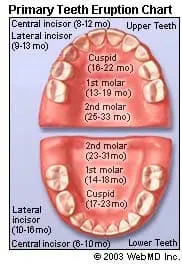
The following chart shows when your child's primary teeth (also called baby teeth or deciduous teeth) should erupt and shed. Eruption times vary from child to child.
As seen from the chart, the first teeth begin to break through the gums at about 6 months of age. Usually, the first two teeth to erupt are the two bottom central incisors (the two bottom front teeth). Next, the top four front teeth emerge. After that, other teeth slowly begin to fill in, usually in pairs -- one each side of the upper or lower jaw -- until all 20 teeth (10 in the upper jaw and 10 in the lower jaw) have come in by the time the child is 2 ½ to 3 years old. The complete set of primary teeth is in the mouth from the age of 2 ½ to 3 years of age to 6 to 7 years of age.
| Primary Teeth Development Chart | ||
| Upper Teeth | When tooth emerges | When tooth falls out |
| Central incisor | 8 to 12 months | 6 to 7 years |
| Lateral incisor | 9 to 13 months | 7 to 8 years |
| Canine (cuspid) | 16 to 22 months | 10 to 12 years |
| First molar | 13 to 19 months | 9 to 11 years |
| Second molar | 25 to 33 months | 10 to 12 years |
| Lower Teeth | ||
| Second molar | 23 to 31 months | 10 to 12 years |
| First molar | 14 to 18 months | 9 to 11 years |
| Canine (cuspid) | 17 to 23 months | 9 to 12 years |
| Lateral incisor | 10 to 16 months | 7 to 8 years |
| Central incisor | 6 to 10 months | 6 to 7 years |
Other primary tooth eruption facts:
- A general rule of thumb is that for every 6 months of life, approximately 4 teeth will erupt.
- Girls generally precede boys in tooth eruption.
- Lower teeth usually erupt before upper teeth.
- Teeth in both jaws usually erupt in pairs -- one on the right and one on the left.
- Primary teeth are smaller in size and whiter in color than the permanent teeth that will follow.
- By the time a child is 2 to 3 years of age, all primary teeth should have erupted.
Shortly after age 4, the jaw and facial bones of the child begin to grow, creating spaces between the primary teeth. This is a perfectly natural growth process that provides the necessary space for the larger permanent teeth to emerge. Between the ages of 6 and 12, a mixture of both primary teeth and permanent teeth reside in the mouth.
Why Is It Important to Care for Baby Teeth?
While it's true that baby teeth are only in the mouth a short period of time, they play a vital role. Baby teeth:
- Reserve space for their permanent counterparts
- Give the face its normal appearance.
- Aid in the development of clear speech.
- Help attain good nutrition (missing or decayed teeth make it difficult to chew, causing children to reject foods)
- Help give a healthy start to the permanent teeth (decay and infection in baby teeth can cause damage to the permanent teeth developing beneath them)
To understand the problems that decaying baby teeth can cause in permanent teeth, see Oral Health Problems in Children.
Children should usually be seen by a dentist by the age of 1 or within 6 months after their first tooth comes in.
What Happens at the First Dental Visit?
The first dental visit is usually short and involves very little treatment. This visit gives your child a chance to meet the dentist in a nonthreatening and friendly way. Some dentists may ask the parent to sit in the dental chair and hold their child during the exam. Or you might wait in the reception area during part of the visit so that your dentist can build a relationship with your child.
During the exam, your dentist will check all of your child's teeth for decay, examine their bite, and look for any potential problems with the gums, jaw, and oral tissues. If necessary, the dentist or hygienist will clean teeth and assess the need for fluoride. They will also educate parents about oral health care basics for children, discuss dental developmental issues, and answer any questions.
Topics your dentist may discuss with you might include:
- Good oral hygiene practices for your child's teeth and gums and cavity prevention
- Fluoride needs
- Oral habits (thumb sucking, tongue thrusting, lip sucking)
- Developmental milestones
- Teething
- Proper nutrition
- Schedule of dental checkups. Many dentists like to see children every 6 months to build up the child's comfort and confidence level in visiting the dentist, to monitor the development of the teeth, and promptly treat any developing problems.
You will be asked to complete medical and health information forms concerning the child during the first visit. Come prepared with the necessary information.
What's the Difference Between a Pediatric Dentist and a Regular Dentist?
A pediatric dentist has at least 2 more years of training beyond dental school. The training focuses on management and treatment of a child's developing teeth, child behavior, physical growth and development, and the special needs of children's dentistry. Although either type of dentist can handle your child's oral health care needs, a pediatric dentist, their staff, and even the office décor are all geared to care for children and to put them at ease. If your child has special needs, think about getting care from a pediatric dentist. Ask your dentist or your child's doctor what they recommend.
When Should Children Get Their First Dental X-Ray?
There are no rules for when to start dental X-rays. Some children who may be at higher risk for dental problems (for example, those prone to baby bottle tooth decay or those with cleft lip/palate) should have X-rays taken earlier than others. Usually, most children will have had X-rays taken by the age of 5 or 6. As children begin to get their adult teeth around the age of 6, X-rays play an important role in helping your dentist to see if all of the adult teeth are growing in the jaw, to look for bite problems, and to find out if teeth are clean and healthy.
Nutrition and Your Child’s Teeth
What your child eats affects their teeth. Too many carbohydrates, sugar (for example, from cake, cookies, candies, milk, and other sugary foods and beverages), and starches (such as pretzels and potato chips) can cause tooth decay. How long carbohydrates remain on the teeth is the main culprit behind tooth decay.
The best thing you can do as a parent is to teach your child to make healthy food choices. Here are some tips:
- Try fruits and vegetables. Offer fruits and vegetables as a snack instead of carbohydrates. Fruits and vegetables with a high volume of water, such as pears, melons, celery, and cucumbers, are best. Limit banana and raisin consumption, as these have concentrated sugar, or if you serve these fruits, try to brush your child's teeth right away after they are eaten.
- Choose cheese. Serve cheese with lunch or as a snack, especially cheddar, Monterey Jack, Swiss, and other aged cheeses, which help to trigger the flow of saliva. Saliva helps wash food particles away from teeth.
- Avoid sticky, chewy foods. Raisins, dried figs, granola bars, oatmeal or peanut butter cookies, jelly beans, caramel, honey, molasses, and syrup stick to teeth, making it hard for saliva to wash the sugar away. If your child consumes these types of products, have them brush their teeth right after eating.
- Serve sugary treats with meals, not as snacks. If you plan to give your child any sweets, give them as desserts just after the meal. There's usually more saliva in the mouth around mealtime, making it easier to wash food away from teeth. The mealtime beverage also helps wash away food particles on teeth.
- Get your children in the habit of eating as few snacks as possible. How often your child snacks is far more important than the how much they eat. Time between meals allows saliva to wash away food particles that bacteria would otherwise feast on. Frequent snacking, without brushing right after, provides constant fuel to feed bacteria, which leads to plaque buildup and tooth decay. Try to limit snacks as much as possible and to one or two a day.
- Avoid sugary foods that linger on the teeth. Lollipops, hard candies, cough drops, and mints all contribute to tooth decay because they continuously coat the teeth with sugar.
- Buy foods that are sugar-free or unsweetened.
- Never put your baby to bed with a bottle of milk, formula, juice, or soda.
- Offer your child plain water instead of juice or soda. Juices, sodas, and even milk contain sugar. Water does not harm the teeth and aids in washing away any food particles that may be clinging to teeth.
- Include good sources of calcium in your child's diet to build strong teeth. Good sources include milk, broccoli, and yogurt.
Other Tips for Your Child's Teeth
- If your child chews gum, opt for xylitol-sweetened or sugar-free gum. Xylitol can reduce the amount of bacteria in the mouth, and the chewing action helps boost the flow of saliva.
- Brush with fluoride toothpastes. The best way to prevent tooth decay is to use a toothpaste with fluoride every day. Current recommendations are to use fluoride toothpaste for all ages, but use a very small amount for younger children. The fluoride seeps inside the tooth to reverse early decay. Brush your child's teeth at least twice a day and after each meal or snack if possible. If brushing between meals is not possible, at least rinse the mouth with water several times.
- Floss your child's teeth daily. Do it at least once a day to help remove particles between teeth and below the gum line.
- Rinse with fluoride mouthwash. A fluoride mouthwash can help prevent tooth decay. Use only after 6 years old.
- Brush your child's teeth after giving their medicine. Medicines such as cough syrups have sugar that bacteria in the mouth use to make acids. These acids can eat away at the enamel.
Easing Your Child’s Fear of the Dentist
Parents and dentists each play an important role in making a child's first dental appointment a positive experience. Any anxiety that parents show will be picked up by the child. And an unfriendly dentist can cause unnecessary fear in the child.
Parents' Role in the Dental Visit
To help the dental visit go more smoothly:
- Tell your child about the visits, but limit the details. Answer any questions with simple, to-the-point answers. Let the dentist answer more complex or detailed questions. Dentists are trained to describe things to children in a nonthreatening way and in easy-to-understand language.
- Avoid the use of words like “hurt,” “shot,” or “painful.”
- Don't tell your child about an unpleasant dental experience that you've had.
- Stress to your child how important it is to maintain healthy teeth and gums and that the dentist is a friendly doctor whose job it is to help do this.
- Don't promise a reward for going to the dentist.
Keep in mind that it is perfectly normal for children to be fearful. Some are afraid of being separated from their parents; others are afraid of the unknown; others are afraid of being injured. A dentist who treats children will know how to cope with your child's fears and anxiety and put them at ease.
Dentist's Role
Children may express fear in a number of ways. Some may cry; others may throw temper tantrums. Dentists often will use techniques to ease children's fears, including:
- The dentist should talk in a friendly voice that could become firmer if necessary.
- Simple words should be used to describe the procedure. Sometimes, dentists will demonstrate the procedure on a doll or another person before doing it on the child.
- Many times, dentists will tell stories or engage the child in conversation as a means of drawing attention away from the procedure.
- Dentists often will use body language, such as a simple smile or frown, to reinforce positive behavior and discourage negative behavior. Praise and compliments should be given to reinforce good behavior.
- The dentist may use sedation to help the child relax and be more comfortable, if necessary. The two most common types of sedation that might be used in children are nitrous oxide ("laughing gas") or an oral sedative (such as Valium).
If your dentist does not take steps to ease your child's fears, consider finding another dentist. It is important that your child has a positive experience at the dentist during their early years so that they do not develop an ongoing fear of oral health care providers.
