There's no cure, but treatment for age-related macular degeneration (AMD) may slow the disease and keep you from having serious loss of vision. Dry macular degeneration is the most common type. It’s when the macula – the part of the retina that helps you see clearly straight in front of you – gets thinner as you age. It can advance into wet macular degeneration, which is when blood vessels grow under your retina and leak.
Diagnosis
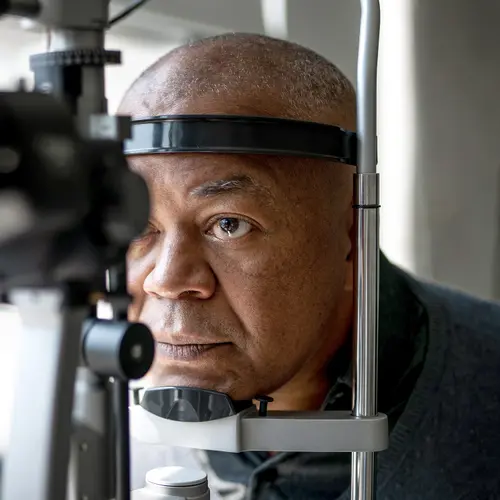
Your doctor can check you for age-related macular degeneration when you go in for a routine eye exam and have your eyes dilated.
An early diagnosis will let you start treatment that may delay some symptoms or make them less serious. They'll test your vision and also examine your retina – a layer of tissue at the back of your eye that processes light. They'll look for tiny yellow deposits called drusen under the retina. It's a common early sign of AMD. If you have a lot of larger drusen spots, you could have dim or cloudy vision or a blurry area in your central vision. Your doctor may also ask you to look at the Amsler grid. If some of the lines appear wavy or some of them are missing, it could be a sign of macular degeneration.
If your doctor thinks you have age-related macular degeneration, they may want you to have one or both of these tests:
- Optical coherence tomography (OCT). It's a special photograph that shows a magnified 3D image of your retina. This helps your doctor see whether the layers are distorted.
- Fluorescein angiography. In this procedure, your doctor injects a dye into a vein in your arm. They take photos as the dye reaches your eye and flows through the blood vessels of the retina. The images will show new vessels or vessels that are leaking fluid or blood in the macula, a sign of wet AMD.
Next Steps for Macular Degeneration
Some people with the dry form of AMD can develop the wet form. If you've got the dry form now, it's important to keep a close check on your vision. Check it at least once a week, testing each eye separately. Follow the directions for using an Amsler Grid Chart. You can print one out and put it on your refrigerator, or you can view it on a tablet or computer. Let your doctor know if you notice any changes.
If you have the wet form of macular degeneration, even if it's been treated, you should test your vision to see if any blind spots get bigger or if any new blind spots appear. New blood vessels can show up months or years after you had injections or laser treatment.
If you only have AMD in one eye, your doctor will do regular eye exams on your other eye to check for signs of new problems.
Your Treatment Options
AREDS. A large National Eye Institute study called AREDS (Age-Related Eye Disease Study), shows benefits in intermediate- or late-stage AMD if you take a nutritional supplement. The study found that a certain combination of high-dose vitamins and minerals slowed down both wet and dry age-related macular degeneration, and may help you keep your vision longer. Researchers later tweaked the formula after the study was updated, calling it AREDS2. Though the combination includes fairly common antioxidants, vitamins C and E, copper, and zinc, the nutrients are in much higher doses than you can get in either regular multivitamins or your diet.
Anti-angiogenic drugs. If you have the wet form of AMD, your doctor will inject these medications into your eye. They stop new blood vessels from forming and stop the leaking from the abnormal vessels that cause wet AMD.
Vascular endothelial growth factor (VEGF) is the main protein that causes new blood vessels to form in the macula in wet AMD. VEGF inhibitors reduce leakage from blood vessels, prevent their growth, decrease swelling of the retina, reduce vision loss, and improve vision in wet AMD.
Drugs in this category include:
Inhibition of angiopoietin -2 (Ang-2), another protein involved in blood vessel formation, helps stabilize these fragile new blood vessels, so they don’t leak. It also makes vessels less sensitive to the effects of VEGF.
VEGF/Ang-2 inhibitors include:
Some people who get these drugs have been able to regain vision that they lost from AMD. You may need to repeat the treatment on follow-up visits.
Photodynamic therapy. It's a two-step treatment for wet AMD that uses a light-sensitive drug to damage your abnormal blood vessels. Your doctor injects medication into your bloodstream. The abnormal blood vessels in your eye absorb the medicine. Next, the doctor will shine a laser into your eye to activate the drug. It creates blood clots in the abnormal blood vessels to stop them from leaking.
Laser therapy. Your doctor may suggest a treatment with high-energy laser light that can seal and sometimes destroy actively growing abnormal blood vessels from wet AMD.
Low vision aids. You can get devices that have special lenses or electronic systems that enlarge images of nearby objects.
These can include:
- Reading magnifiers (handheld or electronic)
- Eyeglasses with special lenses
- Glasses with binoculars
- Electronic glasses
- Phone apps
- Large-print products (phones, clocks, print readers)
What's the Outlook?
People rarely completely lose their sight from age-related macular degeneration. You may have poor central vision – the vision looking straight in front of you. But even with advanced AMD, you'll still be able to see things to the side, outside your direct line of sight. And you'll still be able to do many of your regular activities.
With the serious form of either wet or dry AMD, your central vision may decrease to less than 20/200 in both eyes. If that happens, even though you'll have peripheral vision, your vision problems would meet the definition of legal blindness.
The dry form of AMD, which is much more common, usually gets worse more slowly, allowing you to keep most of your vision.
Sometimes, even after you get treatment for wet AMD, the condition can come back. Test your vision regularly and follow the recommendations of your doctor. The right treatment not only slows your vision loss, but it can improve your vision.