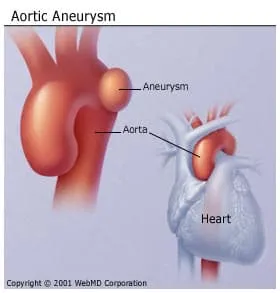
If you get an aneurysm, it means you have a bulge in the wall of an artery. It happens when the pressure of blood passing through has forced a weakened part of the artery to balloon outward or when the blood vessel wall is weakened for a different reason.
Aneurysms can happen in any blood vessel, but they usually form in the belly or chest portions of your aorta -- the main blood vessel that carries blood from your heart -- or in arteries that nourish your brain.
Aneurysms there are serious, while those in other areas, such as your leg, can be less hazardous.
The most serious threat of an aneurysm is that it will burst and cause a stroke or massive bleeding, which can be life-threatening. A large aneurysm can affect your circulation and lead to blood clots.
It's important to get it diagnosed and treated early. Aneurysms often have mild symptoms or none at all, so routine exams can help your doctor check for warning signs.
What Are the Types of Aneurysms?
Aortic aneurysm. As the name suggests, this type happens in your aorta. It can be linked with hardening of the arteries, also known as atherosclerosis. It may be an inherited condition or a complication of high blood pressure or smoking.
Cerebral aneurysm. Also known as a berry aneurysm, you get this kind in the wall of a blood vessel in your brain. Smoking raises your risk of getting one.
Popliteal artery. One of the more common peripheral vascular aneurysms, it is a bulging or weakness in the wall of the artery that supplies blood to the knee joint, calf and thigh.
Ventricular aneurysm. This is a bulge in the wall of your heart. A previous heart attack is the most common cause. In rare cases, a severe chest injury can also lead to it.
What Causes an Aneurysm?
Any condition that causes your artery walls to weaken can bring one on. The most common culprits are atherosclerosis and high blood pressure.
Deep wounds and infections can also lead to an aneurysm. Or you may be born with weakness in one of your artery walls.
How Is an Aneurysm Diagnosed?
To diagnose an aneurysm, your doctor will ask you questions, including whether another member of your family has had one. Then, they’ll give you a complete exam, during which they’ll:
- Listen to your heart
- Check your blood pressure
- Listen to the arteries in your neck
- Feel your abdomen for a mass
- Look behind the knee for popliteal aneurysms
If your doctor thinks you have an aneurysm in your aorta, the main artery in your body, you may get an ultrasound test. This is painless and can pinpoint and measure an aneurysm. If they think one is in your chest, you might get a CT scan.
If your doctor is concerned that you have one in your brain, you may get a CT scan or an invasive test called an angiogram. During this, dye is injected into an artery in an arm or leg and travels to your brain. A picture of your brain is then taken. The dye will make it easier for your doctor to see any problems.
An MRI can also check your aorta or blood vessels in your brain.
How Is an Aneurysm Treated?
The only way to treat an aneurysm is to have it repaired with surgery or an endovascular procedure.
Sometimes, surgery isn’t possible, or it may pose more danger than the aneurysm. Careful monitoring and medication may be best in that case.
Your doctor will figure out the size, type, and location of the aneurysm. What they find will help determine your best treatment.
For inoperable aneurysms, you may be prescribed drugs to lower your blood pressure or ease the force of your heart's beating. Your chance of it bursting will go down.
Even for an operable aneurysm, your doctor may first try medication and a wait-and-see approach, monitoring its growth.
You may need surgery if your doctor finds that the aneurysm has become big enough to be dangerous. A surgeon can treat it by inserting a clip that cuts off blood flow to the affected area.
In some cases, the aneurysm can be removed. That section of artery can be replaced with a synthetic graft.
How Can I Prevent an Aneurysm?
The most important thing you can do to prevent aneurysms is to control your blood pressure.
If you have a family history of stroke or heart disease, make changes in your diet and lifestyle to improve your health.
- Exercise regularly.
- Watch what you eat.
- If you smoke, stop.