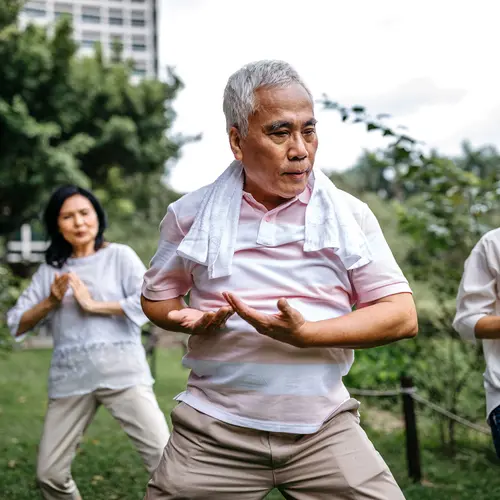
Work is a walk in the park for Clay Cockrell. Instead of seeing patients in a traditional office setting, the Manhattan-based licensed clinical social worker practices therapy that combines exercise with psychotherapy -- mostly in Central Park and Battery Park.
"It's very similar to traditional psychotherapy," he tells WebMD, "except you are walking while you are talking about issues. I have found that bringing a little bit of movement enriches the counseling session. My clients are intrigued by the idea and are naturally drawn to being outside."
Kate Hays, PhD, is the author of Working It Out: Using Exercise in Psychotherapy and has incorporated sports psychology into her clinical practice for more than two decades. Now located in Toronto, Hays continues to explore the mind-body connection in her consulting practice, The Performing Edge, and is past president of the American Psychological Association's division of exercise and sport psychology.
Hays says she first encountered the concept of movement and therapy in the early 1980s -- reading such books as Thaddeus Kostrubala's The Joy of Running. The hypothesis is that rhythmic exercise, such as walking, can be conducive to the process of self-discovery.
Hays cites three key reasons for combining exercise and therapy:
- It encourages a patient to be more physically active for mental and physical reasons.
- It helps a patient get "unstuck" when confronting difficult issues.
- It spurs creative, deeper ways of thinking often released by mood-improving physical activity.
"Some patients may become anxious when confronting something difficult in a traditional seated, face-to-face interaction," she says. "Walking in parallel with visual distractions may allow for easier engagement."
Walk and Talk Therapy: Tapping Into Nature's Healing Power
Cathy Brooks-Fincher, aBrentwood, Tenn.-based licensed clinical social worker with 20 years of experience, has also found this to be true. An avid runner and athlete, she has observed that patients at all levels of fitness can benefit from fresh air and exercise when it comes to processing their feelings. She initially began using walk and talk therapy with teenagers who were having a hard time opening up.
"When I took them into an adjacent park, I found that patients were much more relaxed and the sessions were much more productive," she tells WebMD. "Patients have verified that looking forward rather than directly at a therapist can help them open up."
Brooks-Fincher also praises the "healing power of nature." She says many patients consider the association of being outdoors with recreation and vacation, two very positive things that most people want to experience more.
"We have a beautiful setting in which to do this, a public park with a paved path that runs along a small river," she says. "There are turtles, deer, birds, and a horse farm; restrooms and water fountains are nice assets. Clients who try walk-and-talk often have very dramatic shifts in their thinking about relationships in their lives."
Licensed clinical social worker Carlton Kendrick, EdM, who is based in Cambridge, Mass., agrees. He got his start using exercise and therapy when working with institutionalized and incarcerated patients in the early 1970s.
"When I got people walking on the grounds, listening to cows mooing and birds singing, having to avoid a rock in the road, engaged in a multi-sensory experience, the result was the patients were much more talkative and relaxed."
Walk and Talk Breakthroughs
Movement propels people forward -- literally and figuratively.
"Something changes when people warm to this [therapy]," Kendrick says. "They come in their body armor -- their suits -- and when they change their clothing and when they see me in my sweats and sneakers, they loosen up. The literal and metaphorical ability for them to move, to experience freedom and a lessened sense of confrontation, of 'being under the microscope,' that they may predictably feel in my or anyone's office setting.
"The comfort of a patient establishing his or her own rhythm is secure," he continues. "And it's a subtle bond -- we are in sync, we are on an adventure together. Being in nature takes [the session] out of my power base and into the streets and hills. It's much more of an equal turf and provides more parity."
Hays agrees. "At any point in psychotherapy where a patient is at something of an impasse or if a patient is alienated, those are situations I would be likely to offer this as a way through whatever is going on. A patient might be able to view a situation with more clarity, more insight, and make connections which she otherwise might not be able to because of the biochemical effects of being active."
Debbie, one of Cockrell's patients, says she tried standard therapy in the past but praises the benefits of walk and talk.
"In my experience," she tells WebMD, "taking four walls out of the equation helped me open up and feel more comfortable. He plans the route perfectly; all I have to do is follow his lead, which allows me to get lost in my thoughts and emotions and really work it out without thinking of the ticking clock," says Debbie who asked that only her first name be used. "It allows me to open up more than I would have sitting in a room staring at someone. Also since my blood is pumping, I'm more open to new ideas, my brain is working in a different way."
Walk and Talk Therapy: Is It Right for You?
Numerous scientific studies have shown the positive effects of exercise on the brain, especially for people with depression.
Brooks-Fincher says that depressed patients often "turn a corner" when using this practice.
Additionally, anxious or grief-stricken patients are also well served by walk and talk psychotherapy. "Because grief can be so totally consuming and feel so heavy, having the counterpoint of being outdoors and accomplishing something positive for one's health can provide a sense of aliveness."
She also says that relationship conflicts are where "light bulbs really go on in terms of having a different perspective. In an outdoor setting, [patients] are more receptive to feedback from the therapist."
Kendrick agrees. "Clients who are feeling trapped in a relationship or a job, or who are pretending to be somebody they are not will feel a sense of freedom" with walk and talk therapy." Hays adds that domestic abuse patients may also benefit by "being able to frame things more positively."
Cockrell has also found walk and talk to be especially good for his male patients.
"I have a theory that men have difficulty with eye contact in the office, chair to chair, knee to knee, revealing very private and possibly painful things," he tells WebMD. "Walking side-by-side can help a man become vulnerable."
In addition, he says substance abusers can benefit from walk and talk movement.
Walk and Talk Therapy: Confidentiality Concerns
What happens if a client, wrestling with an explosive or emotional issue encounters someone they know -- perhaps a neighbor or work colleague -- during a walking psychotherapy session. Would confidentiality be compromised? How would that situation be handled to minimize embarrassment? What are the boundaries?
"Those are exactly the kinds of situations that are a therapist's responsibility to raise with the client," says Hays. "If one of us sees somebody we know, we just casually say 'hello' and keep on going. It's not explicit what's going on. In my experience it's been fine, not the slightest bit problematic."
Although it was of initial concern to Cockrell, he says, "It's just two people walking and talking; there is nothing to say this is a therapy session. If I see a group of people I recognize I can steer us in another direction. I've not had a client say it's uncomfortable."
Brooks-Fincher says occasionally she or her clients will be greeted by someone they know when in a public area. "It is something I discuss up front. It has been an interruption but not an impediment. We don't slow down and people realize we are in intense conversation."
Likewise, weather doesn't seem to be a deterrent to dedicated walk and talk patients and therapists.
"I walk with my patients 12 months a year," Cockrell says. "Once my clients have experienced walk and talk they don't want to go to the office. New Yorkers spend so much time indoors -- at home, in the office, in the subway -- it's a nice break. It's rarely so bad they can't put on an extra coat and gloves or carry an umbrella."
Finding a Therapist Who Offers Walk and Talk Therapy
Although not new, a limited number of therapists offer walk and talk therapy. If yours doesn't, feel free to request it, say experts. None of the therapists WebMD spoke with charge a premium for a walk and talk therapy session over a traditional office session. Hays stresses that therapists don't need any special training to conduct walk and talk therapy, so if it appeals to you, bring up the possibility.
"I'm getting emails from across the country and across the world," says Cockrell of interest in the walk and talk movement. "It's highly appropriate for patients to take control of treatment and ask [a therapist] to think about adding this to his practice."
The therapists themselves also reap benefits from the practice of walk and talk therapy, which, in turn, benefits the client.
"This has been a very positive thing for me," says Cockrell. "I find it invigorating. The result is that I'm on my game and my patients feed off my energy. I'm very and focused, very goal-oriented, which is beneficial for them."
Adds Brooks-Fincher, "I think it keeps me fresh as a therapist to be doing something a little bit different."
"Sitting is passive, it's a deflated posture," says Cockrell. "Walking is literally moving ahead. People feel like they are moving forward in their issues. They can tackle things better and faster."
Patient Debbie agrees. "I have definitely seen a lot of change and growth in myself all for the positive. I also look forward to seeing [Cockrell]; the sessions are unconventional and there's a sense of embarrassment that I just don't feel now. I would definitely recommend it to others."