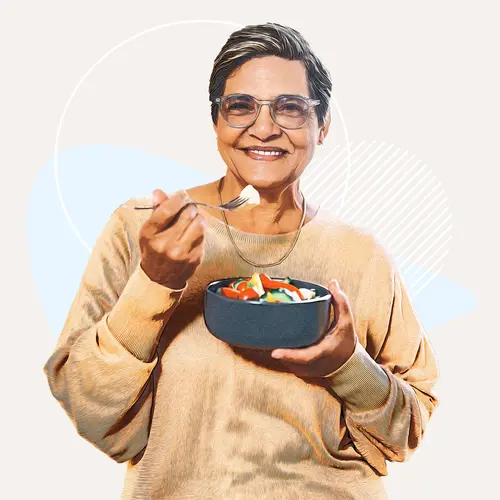

When you eat a balanced diet, you give your body the nutrients it needs for healthy functioning. A balanced diet has the right proportion of minerals, vitamins, other essential nutrients, and optimal calories for your body’s makeup.
A balanced diet features foods from the following core elements:
- Proteins
- Fruits
- Vegetables
- Grains
- Fats/oils
- Dairy
Why Is a Balanced Diet Important?
A balanced diet helps you maintain good health throughout your life and reduces the risks of developing chronic health conditions and diseases.
When you have a poor diet, you function at less optimal levels and may experience bouts of infection, fatigue, brain fog, or other health conditions.
Some of the leading causes of death, including heart disease, type 2 diabetes, cancer, and stroke, have a strong connection with a poor diet.
Understanding Calories
The foods you eat contain a certain number of calories. Rather than a physical component, calories are a measure of how much energy your body gains when it breaks down and metabolizes the food.
The number of calories your body needs depends on your age, gender, and activity level.
In general, men need more calories than women. Children need fewer calories than adolescents, whereas young adults aged 14-30 require the most calories of all age ranges. Caloric needs decline as you move through adulthood, so an older adult aged 85 would need fewer calories than an adult aged 50.
Choosing a Balanced Diet
Opt for nutrient-dense whole foods that provide the most nutritional value for the number of calories created. This ensures that your body processes high-quality components and fuels you for the long term.
High-quality foods have a variety of nutrients:
- Vitamins
- Minerals
- Fiber
- Healthy fats
- Carbohydrates
- Protein
- Other components such as antioxidants
Foods to Avoid or Limit
To avoid empty calories, limit your intake of foods considered nutrient-poor. Examples of this broad range of foods include:
- Highly processed foods
- Refined grains
- Refined sugars
- Sweetened drinks
- Red and processed meats
- Saturated and trans fats
- High-glycemic foods
You should also limit your intake of salt and added sugars. Too much sodium can increase blood pressure and risks for heart disease and stroke, whereas too much sugar can increase risks for tooth decay and obesity.
Alcoholic beverages affect cholesterol, triglyceride, and insulin levels. They can also increase risks for liver inflammation or scarring, elevated blood pressure, weight gain, or even some types of cancer.
The Six Core Food Elements
A balanced diet starts with the right ratios of foods from the six core elements:
Proteins
Proteins should make up ¼ of your plate or about 5.5 ounces each day. Choose lean red meats, seafood, poultry, eggs, nuts, beans, lentils, and seeds.
Fruits
Fruits should make up ¼ of your plate, or about 2 cups a day. Choose dried, fresh, or frozen fruits, but remember that dried fruits are more concentrated in natural sugars. Fruit juices have high sugar levels and should not be a major part of your diet. Also consider a variety of fruit colors to get the most nutrients.
Vegetables
Vegetables should account for ¼ of your plate if you’re eating fruits as well. Otherwise, they should fill ½ of your plate and be equivalent to 2.5-3.5 cups each day. When you choose vegetables, select from different subgroups to enjoy the most benefits.
Subgroups include:
- Dark green vegetables
- Red and orange vegetables
- Legumes
- Starchy vegetables
- Other vegetables
Grains
Grains should take up ¼ of your plate and add up to about 6 ounces per day. Your grains should come from whole grains wherever possible including:
- Buckwheat
- Oats
- Dark rye
- Quinoa
- Whole-grain cornmeal
- Wild or brown rice
- Whole wheat
- Bulgur
- Amaranth
Fats/Oils
Although some fat is essential for a healthy diet, the type and quality available vary. Choose healthy unsaturated oils such as extra virgin olive oil, sunflower oil, and safflower oil, and limit your intake to about 27 grams a day. Foods rich in healthy fats include chia seeds, ground flax, avocado, nuts, seeds, and fish.
Dairy
Dairy has essential nutrients such as calcium for strong teeth and bones. Aim for 3 cups a day from low-fat or fat-free products such as milk, yogurt, cheese, kefir, and buttermilk.
A healthy diet gives you energy and all the nutrition your body needs. Talk to your doctor if you’re having trouble maintaining a healthy diet or with eating certain foods.
Rating Your Hunger
When you sit down to eat a meal, you want to be hungry, but not ravenous. (Letting your blood sugar get so low that you feel ravenous often leads to binge eating.) And your goal is to stop when you're comfortably full.
To get into the habit of evaluating your hunger, rate your hunger and satisfaction level before and after every meal. Here's a numerical scale you could use:
0: Ravenously hungry, salivating
1: Hungry, belly growling
2: Mildly hungry; you may need a light snack to hold you over, but you could hold out a little longer
3: Satisfied; don't need to eat anymore
4: More than satisfied; overate
5: Stuffed like a Thanksgiving turkey
And whenever you're about to run to the kitchen or break room or detour to the nearest drive-thru, ask yourself these questions first:
- When was the last time I ate? If it was less than 2-3 hours ago, you're probably not feeling real hunger.
- Could a small, nutritious, fiber-rich snack tide you over until the next meal?
- Can you drink a glass of water and wait 20 minutes?
If you find that you don't easily recognize the signs of hunger, schedule your meals and snacks. Divide your eating plan into several small meals, spaced every 3-4 hours. Rate your hunger each time you sit down to eat, and try to become more aware of what real hunger feels like.
More Mindful Eating
Most of us wolf down our food without really tasting it from time to time. Do you suffer from "eating amnesia" when the hand-to-mouth activity becomes automatic—usually in front of the television or while reading a book? Bad habits are hard to break, but if you want to control what you eat, you must become more mindful of everything you put into your mouth.
It helps to slow down and enjoy your meals. Sit down, turn off the television, and create a peaceful environment free of distractions to enjoy your meals.
Remember that the first few bites are always the best (your taste buds soon become less sensitized to the chemicals in food that makes it taste so good). Focus on the quality of the food, not the quantity. Be mindful of each mouthful, and appreciate the food's flavors, aromas, and textures.
Enjoying leisurely meals gives your stomach time to signal to your brain that you are comfortably full. Put your fork down between bites, sip water, and enjoy conversation while you dine.
Deal With Your Hunger
Here are some more tips to help you get in touch with real hunger:
- Exercise portion control. The old expression "your eyes are bigger than your stomach" may be sage advice. Researchers have found that the more food you're served, the more you're likely to eat. The theory is that the environmental cues of portion size override the body's cues of satisfaction.
- Eat foods that are bulked up with water or air, which gives them more volume and makes them more satisfying. Increasing the bulk in your meals helps fill your belly, signals satiety to your brain, and allows you to feel full on fewer calories. Broth-based soups, stews, hot cereals, and cooked grains are good examples of foods that go the distance.
- Fiber can help satisfy hunger and reduce appetite. Choose high-fiber foods such as fruits, vegetables, legumes, popcorn, and whole grains. Starting a meal with a large salad can help you eat fewer calories during the meal because of the fiber and water content of greens and vegetables. Also, keep in mind that fresh fruits have more fiber and water than dried ones.
- Avoid the buffet line. When there are lots of choices, most people eat more. Keep it simple, limit the number of courses, and fill up on high-fiber foods first.
- Include lean protein in your meals and snacks to help them last longer in your stomach. A handful of nuts, some low-fat dairy, soy protein, or lean meat, fish, or chicken will tide you over for hours.
Five Foods to Try
Here are some foods that can help keep you full longer:
- Soup. Start with a broth-based soup (rather than higher-calorie cream soups). Add your favorite cut-up veggies, plus a protein such as beans, chicken, or fish, so you have all the elements of an energy-dense, satisfying meal.
- Smoothies. If they're made with low-fat yogurt and loads of fruit and vegetables, you're getting protein, fiber, and calcium. Smoothies have become a nutritional mainstay.
- Pasta primavera. Start with whole wheat pasta, and then, add a bunch of your favorite sautéed veggies. The more you increase the proportion of vegetables to pasta, the greater the satiety. Studies show that the more veggies you add, the fuller you'll feel.
- Popcorn. It's truly energy dense, plus there's the volume effect. If you have air-popped popcorn (and don't add fat to it), you get a huge amount. Experts say that's a good thing because it gives you lots of sensory satisfaction. There's research showing that the perception of eating a whole lot can trick the system to feel full.
- Big salads. A meal-sized salad needs with a protein like grated cheddar cheese, tofu , beans, or nuts, with a low-fat dressing.
Also, studies show that fish provides more satiety than chicken or beef. The type of protein in fish is what makes the difference. Veggies, such as sweet potatoes, white potatoes (with the skin), a handful of carrots, and whole-grain breakfast cereals or bread, are also satisfying.
Tomatoes are water-intensive, so they are high on the satisfaction scale. For a snack, combine a sliced tomato and a few pretzels—plus a drizzle of balsamic vinegar or olive oil on the tomato. It will have far more staying power than pretzels alone.
But beware of peanut butter—although it definitely helps keep hunger pains under control, there's the big risk of eating too much. Just a light smear on a bagel or apple is all you need. Diving spoon-first into the jar is a no-no.