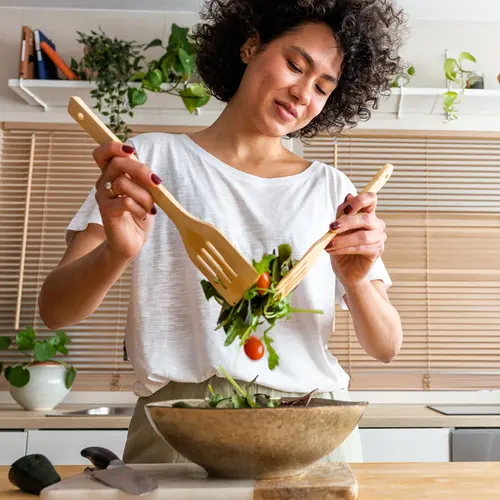
"The Japanese diet is the iPod of food," says Naomi Moriyama, co-author of Japanese Women Don't Get Old or Fat: Secrets of My Mother's Tokyo Kitchen, "it concentrates the magnificent energy of food into a compact and pleasurable size." And you don't have to cook Japanese-style to enjoy the diet's healthy foundations -- just eat more fish, vegetables, and fruit; serve smaller portions; eat mindfully and slowly; and add some healthy options like tofu and rice, she says. Here's how to get started.
First, the benefits. "Thanks to the relatively healthier Japanese diet and lifestyle, Japanese women and men live longer and healthier than everyone else on Earth," Moriyama tells WebMD. Not only can they expect to live 86 and 79 years respectively (compared to 80 and 75 years for Americans), but they can also anticipate an average of 75 years lived healthy and disability-free, the World Health Organization reports. On top of that, Japanese people enjoy the No. 1 lowest obesity rate in the developed world -- 3% -- versus 11% for the French and 32% for Americans, according to the International Obesity TaskForce. "You might think it's all in our genes," Moriyama says. "But when Japanese people adopt a Western-style diet, they put on weight quickly."
Eat with your eyes. "The magic of Japan-style eating is a healthier balance of filling, delicious lower-calorie foods, presented with beautiful portion control in pretty little dishes and plates," Moriyama says. This way of dining encourages you to "eat with your eyes" by enjoying the beauty of your food. The result? You'll want to slow down to savor every bite, which means eating less, because it gives your brain time to realize your body is full.
According to Moriyama, the average Japanese person eats about 25% fewer calories per day than the average American, which could partly explain their lengthy lifespan. Eating just 8% fewer calories per day, while moderately increasing your activity level, may be enough to promote longer life, research from the University of Florida College of Medicine suggests.
And cutting calories doesn't have to be painful. The secret is to replace energy-dense foods (those containing a higher number of calories per gram), like chocolate, potato chips, and cookies, with those that are less energy-dense, like fruits, vegetables, and broth-based soups (all, not coincidentally, a daily part of the Japanese diet). In a study from Pennsylvania State University, researchers served women meals that were 25% smaller than average and contained 30% fewer calories according to the principles of energy density. They ended up eating an average of 800 calories less per day -- all without even missing the extra food.
Portion power. In Japan, food is served on separate small plates and bowls instead of on one big plate. Diners take turns having little tastes of everything, Moriyama says. Serving smaller portions may be one of the best secrets for eating healthfully and losing weight. Research shows that when we're served more, we tend to eat it -- whether we planned to and were hungry for it or not.
People eat up to 45% more food when served bigger helpings, scientists from the University of Illinois, Urbana-Champaign report. When asked to identify what determines the size of the portions they eat, nearly seven out of 10 respondents in a recent American Institute for Cancer Research (AICR) survey claimed that the amount they were accustomed to eating was what determined the amount of food they placed on their plates.
This is both bad news and good news. Bad, in that it's proof we tend to eat without thinking. And good, in that it's possible to change the amount of food we eat. How? By becoming used to eating less. For instance, try replacing platter-size dinner plates with salad or dessert plates. You'll end up eating less, while barely noticing, because your plate will look just as full. Or try serving food from measuring cups for a week or so, says Lisa R. Young, PhD, RD, author of The Portion Teller Plan, -- just to get used to the amount of food you should be eating. "You don't have to shrink all your portions, just portions of high-calorie, high-fat foods," she says.
A rice foundation. The Japanese diet includes huge amounts of rice -- six times more per person than the average American's diet, Moriyama tells WebMD. A small bowl is served with almost every meal, including breakfast. A low-fat, complex carbohydrate, rice helps fill you up on fewer calories, leaving less room in your belly for fattening foods like packaged cookies and pastries, which can contain heart-damaging trans fats. For extra health benefits, serve rice the Japanese way, cooked and eaten with no butter or oil.
Veggie delight. "Japan is kind of a vegetable-crazed nation," Moriyama says. When Japanese women were asked which home-cooked meals they most loved to prepare for their families, "mixed vegetables simmered in seasoned broth" received the highest ranking. Red bell peppers, green beans, zucchini, eggplant, onions, burdock, tomatoes, green peppers, lettuce, carrots, spinach, bamboo shoots, beets, lotus root, turnips, daikon (or giant white radish), shiitake mushrooms, sweet potatoes, and seaweed (or sea vegetables), such as kombu, nori, and wakame all have a place in the Japanese diet.
As many as four or five different varieties are served in a single meal -- and no one thinks it odd to have vegetable soup or a salad for breakfast. Veggies are served simmered in seasoned broth, stir-fried in a small bit of canola oil, or lightly steamed -- all methods that maintain a maximum amount of nutrients.
A good catch. Fish, especially fatty fish -- like Japanese favorites salmon and fresh tuna, mackerel, sardines, and herring -- are a great source of omega-3 fatty acids, which are known for their heart-health and mood-boosting benefits, Moriyama tells WebMD. And though Japan accounts for only 2% of the world's population, its people eat 10% of the world's fish. The flipside of Japan's fish craze means the Japanese eat less red meat, which contains artery-clogging saturated fat that, if eaten to excess, can lead to obesity and heart disease.
Soy good. When consumed in moderation, natural soy products like tofu and edamame beans are a great protein alternative to red meat because they have little or no saturated fat, says Moriyama. Japanese meals often include more than one soy-based dish, like miso soup (miso is fermented soy beans) and chunks of tofu.
Delicious desserts. A typical Japanese dessert is an assortment of seasonal fruits, peeled, sliced, and arranged on a pretty plate, Moriyama says. People do enjoy Western desserts like ice cream and cakes, but they're usually offered in smaller portions and subtler flavors compared to the West. A cup of Japanese green tea is the perfect end to any meal.
Healthy options. It only takes a few small changes to make the Japanese diet even healthier. The first requires swapping the ubiquitous white rice for brown. Japan's original ancient power food, brown rice is a great whole-grain, high-fiber source of "good carbs," Moriyama says. The second change involves reducing sodium intake, which is much too high in the Japanese diet because of the large amounts of soy sauce and pickled foods. When available, choose the lower-sodium varieties of miso, soy sauce and teriyaki sauce, Moriyama says, -- and even then, you should use them in small amounts. On a piece of sushi for example, just a drop or two of lower-sodium soy sauce is all you need.
Beautiful food. Bursting with beauty, taste, and health benefits, the Japanese diet has something to offer anyone who wants to live longer, slimmer, and healthier. Experiment with fish, rice, or vegetables served on your most delicate dishes, and reap the benefits for yourself -- chopsticks not required.
Japanese Recipes
Kinpira (Burdock and Carrot)
Serves 4
Kinpira is one of the classic Japanese home-cooked dishes, featuring two great root vegetables, burdock and carrots. In this sauteed dish the burdock combines beautifully with the sweet carrots, red peppers and roasted sesame seeds. Crunchy, soft, sweet and hot, no wonder this Japanese recipe is a popular winter dish in Japan.
Burdock, or gobo, is a fiber-rich Japanese root vegetable with a delectable earthiness. Look for burdock at Japanese markets or gourmet supermarkets.
1 medium (8 ounce) burdock root
1 tablespoon canola oil or rice bran oil
2 dried Japanese (or Thai chili, Santaka or Szechuan) red peppers
1 cup carrot, cut into matchstick-sized slivers
1 tablespoon sake (rice wine)
1 tablespoon reduced-sodium soy sauce
2 teaspoons mirin (a cooking wine made from glutenous rice)
1 teaspoon granulated sugar
1 teaspoon toasted and ground sesame seeds
1. Scrub the exterior of the burdock root with a vegetable brush to remove excess dirt and the skin. Cut the burdock root into 2½ to 3-inch-long matchsticks, and rinse quickly under cold water. You will have approximately 2 cups of burdock root matchsticks.
2. Heat the oil in a medium skillet over medium-high heat. Add the red peppers and saute for 30 seconds. Add the burdock root and saute until tender, about 3 minutes; it will appear translucent on the surface. Stir in the carrot and saute for 2 minutes.
3. Reduce the heat to low and add the sake, soy, mirin, and sugar. Stir the vegetables for 1 minute more to allow them to absorb the sauce. Remove and discard the red peppers and arrange the vegetables in a mound in the center of a serving bowl and garnish with the sesame seeds.
Excerpted from Japanese Women Don't Get Old or Fat by Naomi Moriyama and William Doyle. Copyright © 2005 by Naomi Moriyama and William Doyle. Excerpted by permission of Delta, a division of Random House, Inc. All rights reserved. No part of this excerpt may be reproduced or reprinted without permission in writing from the publisher.
Beef Over Rice
Serves 4
Here's a perfect example of how Japanese home cooks create a delicious and filling beef dish -- with very small portions of beef. An abbreviated version of sukiyaki (a combination of thinly sliced beef and vegetables in a sweet soy broth), this is spooned over hot cooked rice in a bowl.
Thinly sliced beef is available in the freezer section of most Japanese markets. It's convenient to use, extremely tender and perfect for this healthy cold-weather dish. If you choose to purchase the beef in a regular market, freeze the meat before you cut it. This will enable you to carve it (with an extremely sharp knife) into paper-thin slices.
I often think that the best part of this beef bowl isn't the beef, but the hot nutty rice saturated with the sweet beef juices.
2 cups dashi (a fish-and-sea-vegetable stock, available online or in Asian grocery stores)
¼ cup sake (rice wine)
1 medium yellow onion, peeled, halved and cut into thin crescents
1 Tokyo negi (or 1 small leek), with roots and rough portion of the top cut off, cleaned, rinsed and cut diagonally into thin slices
3 tablespoons reduced-sodium soy sauce
1 tablespoon granulated sugar
1 teaspoon fine-ground sea salt
1 teaspoon mirin (a cooking wine made from glutenous rice)
½ pound very thinly sliced beef fillet (about 1/8 inch thick), or, if you prefer, ground beef
6 cups hot cooked brown or white rice
1 scallion, roots and top portion cut off, and thinly sliced
1. Place the dashi and sake in a medium saucepan over high heat. Add the onion and Tokyo negi (or leek) and bring the mixture to a boil. Reduce the heat to medium and simmer until the vegetables are tender, about 5 minutes. Stir in the soy, sugar, salt, and mirin. Add the beef and simmer until it is just cooked through, about 40 seconds (it will cook rapidly if cut into paper-thin slices).
2. Lay out 4 bowls. Fill each one with 1½ cups of hot cooked rice and ladle even portions of the beef mixture over the top. Garnish each serving with a sprinkling of scallion.
Excerpted from Japanese Women Don't Get Old or Fat by Naomi Moriyama and William Doyle. Copyright © 2005 by Naomi Moriyama and William Doyle. Excerpted by permission of Delta, a division of Random House, Inc. All rights reserved. No part of this excerpt may be reproduced or reprinted without permission in writing from the publisher.