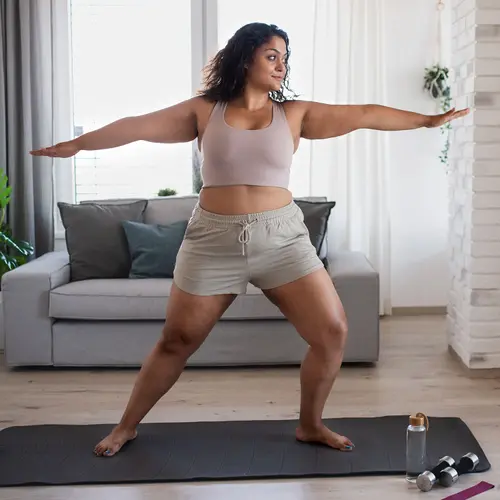

Want to try out yoga but don’t know the first thing about tree pose? Ready to start lifting weights, or turn that walk around the park into a jog? Use these easy how-to's.
Bicep Curl
Grab weights with palms facing forward, feet under hips. Bending arms, lift weights toward shoulders. Straighten elbows and lower weights back down.
Perfect Plank
Lie on your belly. Rest upper body on forearms flat against the floor. Contract abs and butt. Slowly lift torso off the ground. Hold 5 seconds, then lower.
Tree Pose
Stand straight, shifting body weight to right foot with left knee to chest. Turn knee to side, press sole of foot to calf. Put palms together over your head. Hold 5-10 breaths.
Squats
Keep your feet shoulder-width apart, back straight. Bend knees and lower your rear as if sitting down in a chair, keeping knees over ankles.
The Pilates Hundred
Sit on the floor, feet flat, holding the backs of your thighs. Keep the belly in and curl down to the floor. Now curl the head and shoulders up slightly. Pump the arms up and down at your sides. Breathe in for 5 seconds and out for 5 seconds until you hit 50 pumps. Sit up and repeat for a total of 100.
Pilates Roll-Up
Lie on your back with legs straight, feet flexed, arms reaching overhead on the floor. Press your low back into the floor. Exhale and, keeping your navel in, slowly roll up one vertebra at a time until you're sitting up. Slowly roll back down. Repeat 3 to 5 times.
Side Plank
Lie on your side with a bent elbow directly under your shoulder and use your torso muscles to lift your hips up into a side plank.
Sculpt a Better Butt
Like a speed skater, with your feet under your hips, hop sideways to the left on left foot and touch right hand to the floor. Alternate sides. Do 3 sets of 20.
Tone Your Hamstrings
Do deadlifts: Holding free weights, stand with feet hip-width apart. Fold at your hips, keeping your back straight. Move the hips backward as you lower your upper body until it's parallel to the floor and the weights are just below your knees. Slowly return to the starting position. Do 10 reps.
Work Your Abs
Try the canoe twist: Stand upright, feet apart. Lock fingers in a solid grip. Exhale, sweep hands, arms, shoulders, and chest to the left, like rowing a canoe. At the same time, lift the left knee up and to the right. Inhale, return to starting position. Exhale, do it to the right. Switch for 20 reps.
Get Perfect Posture on a Cardio Machine
The treadmill death grip can cut into your results. Hold on lightly.
Make Your Routine Stick
Keep exercise to 20- to 30-minute sessions, 2-3 days a week. Pick an easy place: home, outside, or at the gym. Track your progress. Reward yourself.
Beat Boredom
Try a new walking or biking route. Even using a different room for your workout can help keep it interesting.
Power Up Before You Start Moving
Make your pre-workout snack mostly carbs with some protein: half a bagel or a large banana with a little peanut butter.
Start Interval Training
Warm up for 5 minutes. Then push up the pace for 1 to 2 minutes. Return to your typical speed for 2 to 10 minutes and repeat for the length of your workout. As you get more fit, shorten the rest time and spend more time working harder.
Go from Walking to Running
Run 5 to 10 seconds out of every minute. Walk the rest of the minute. Gradually adjust the walk/run ratio as you get stronger.
Run Further
Boost your mileage by no more than 10% each week.
Train for a 5K
Pick a 5K race that is 2 to 3 months away. Start slowly, walking or jogging for 10-15 minutes during your first few workout sessions. Add a few minutes each week until you can run for at least 4 miles.
How to Check In With Your Body
Take the Pledge Test
If you can say the Pledge of Allegiance easily while working out, you're in your target aerobic zone. Gasping? Ease up a bit.
Know if You've Worked a Muscle Hard Enough
You've probably worked a muscle "to failure" if you feel burn in the muscle during the last few reps and you can't keep form.
Manage Sore Muscles
Use an ice pack wrapped in a damp thin towel or pillow case for instant relief. Later, use heat to get more blood to your achy places.
Stretch Your Achilles
Face a wall with your right foot in front of the left. Bend your right knee. Keep your left straight and press your hips forward. Lean into the wall. Keep your heels down and knees in line with your feet. Hold 20 seconds, then repeat 3-5 times with each leg.
Stop a Side Stitch
Slow down. Put your hand on your stomach and breathe deeply for 2-4 minutes, making sure your belly rises and falls.
Treat Muscle Cramps
Stop exercising, rest, and hydrate, preferably with a sports drink that can restore your electrolyte balance.
Check Your Flex Quotient
Just for fun: Put one hand behind your head and the other behind your back. Can you touch your fingertips? If you can, you're pretty bendy.