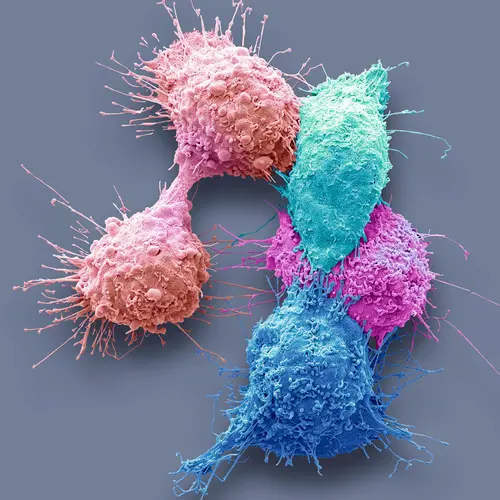
The ovaries are almond-sized organs -- one on each side of the uterus -- that store eggs and make female hormones. When you have ovarian cancer, malignant cells begin to grow in the ovary. Cancer that starts in another part of your body can also spread, or metastasize, to your ovaries, but that is not considered ovarian cancer.
What Causes It?
Researchers have many theories, but no one knows exactly what causes ovarian cancer. Scientists have not been able to find a single chemical in our environment or our diets that they can link specifically to ovarian cancer, unlike some other kinds of cancer.
Certain things -- genetics or the way you live -- can raise the odds that you’ll get ovarian cancer, but that doesn’t necessarily mean you’ll get it.
Some ovarian cancers are linked to gene changes first discovered in families with lots of cases of breast cancer. Those mutations are called BRCA1 (breast cancer gene 1) and BRCA2 (breast cancer gene 2).
If your family came from Eastern Europe or you have Ashkenazi Jewish ancestors, your odds of having one of the BRCA mutations are higher.
Another set of gene mutations that raises your ovarian cancer risk is one that causes Lynch syndrome, also called hereditary nonpolyposis colorectal cancer or HNPCC.
If one of your close relatives (grandmother, mother, sister, daughter) had ovarian cancer, you have an increased risk as well, even if their cancer wasn’t linked to a genetic mutation. Your risk also goes up if you have a family history of breast cancer, colon cancer, uterine cancer, or rectal cancer.
Your risk is higher if you’ve had another type of cancer, like melanoma or cervical cancer.
Other things that can raise your risk of ovarian cancer include:
- Age. Few women younger than 40 get the disease. Most women get ovarian cancer after menopause.
- Obesity. If your body mass index (BMI) is 30 or higher, some studies indicate your risk may go up, but those studies are inconclusive.
- Hormone replacement therapy. While inconclusive, some studies suggest that using estrogen after menopause increases your risk.
Your chances of getting ovarian cancer are also affected by your reproductive history: when your period began and ended, whether you had children, and related issues. You have higher odds of getting ovarian cancer if:
- You never gave birth.
- You had your first child after you were 30 years old.
- Your period started before age 12.
- You started menopause after age 50.
- You never took birth control pills.
- You experienced infertility, even if you didn’t take fertility drugs to treat it.
Other things that may increase your ovarian cancer risk include:
- Smoking
- Using an intrauterine device, or IUD (Researchers disagree on whether these raise your risk.)
- Polycystic ovary syndrome (PCOS), a problem with your endocrine system that leads to enlarged ovaries
- Taking large doses of estrogen over a long period of time without progesterone
- A history of endometriosis (the lining of your uterus grows in the wrong place)
Some people believe using talcum powder near your genitals is linked to ovarian cancer, but the evidence on that is not clear.
Talk with your doctor about early screening options like blood tests and pelvic imaging if any of these risk factors apply to you.
Can I Prevent It?
Ovarian cancer is tricky. It’s hard to spot and spreads faster than any other cancer in the female reproductive system.
Because so little is known about the specific causes of ovarian cancer, there’s not a long list of ways to prevent it.
If your family history points to a higher risk, your doctor can help you decide how best to manage your situation. Options include genetic testing and counseling. If your risk is high, you may decide to have your ovaries removed as a precaution. This surgery is called a prophylactic oophorectomy.
Eating a diet low in fat may lower your risk of ovarian cancer, and in general, exercising and keeping a healthy weight can reduce your risk of many diseases.
Other things that can lower your odds of ovarian cancer include:
- Breastfeeding
- Tubal ligation to prevent pregnancy (also known as “having your tubes tied”)
- Taking hormonal birth control
- Daily aspirin use (although if you aren’t already doing this for another medical reason, you shouldn’t start just to prevent ovarian cancer)
- Hysterectomy (surgery to remove the uterus and cervix)
Ovarian Cancer Recurrence and Survival Rates
Ovarian cancer comes back, or recurs, after treatment in more than 80% of cases. But the odds of this happening largely depend on how far it had spread (called the stage) when you got the diagnosis.
Chances of recurrence by stage are:
- I: 10%
- II: 30%
- III: 70% to 90%
- IV: 90% to 95%
Survival rates are the percentage of people who live a certain amount of time (usually 5 years) after diagnosis. Overall, about 46% of women with ovarian cancer live at least 5 years after diagnosis.
By stage, 5-year ovarian cancer survival rates are:
- IA: 93%
- IB: 91%
- IC: 79%
- IIA: 78%
- IIB: 73%
- IIC: 57%
- IIIA: 59%
- IIIB: 52%
- IIIC: 39%
- IV: 20%
Remember that everyone’s case is different, so these numbers are only a guideline. Your doctor can talk with you about what to expect.